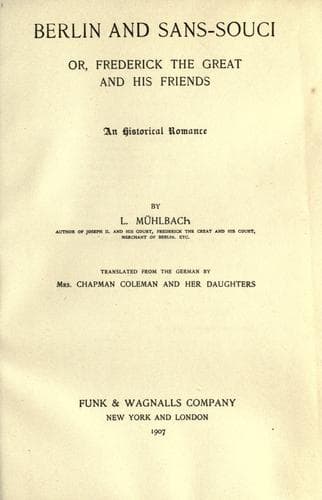
Berlin and Sans-Souci; Or, Frederick the Great and His FriendsMühlbach, L. (Luise)
History
Berlin and Sans-Souci; Or, Frederick the Great and His Friends
Mühlbach, L. (Luise)
Frederick II, King of Prussia, 1712-1786 -- Fiction; Prussia (Germany) -- History -- Frederick II, 1740-1786 -- Fiction
"Then I am willing to take an oath that what I have related was in
the letter. I read it myself, for the lieutenant showed it to me."
"Bring me the letter."
Jaschinsky went, and the king remained alone and thoughtful in his
tent. "If he were a traitor, he would surely not have shown the
letter to Jaschinsky," said the king, softly; "no, his brow is as
clear, his glance as open as formerly. Trenck is no traitor--no
traitor to his country--I fear only a traitor to his own happiness.
Well, perhaps he has come to his reason, I have warned him
repeatedly, and perhaps he has at length understood me.--Where is
the letter?" he asked, as Colonel Jaschinsky reentered.
"Sire, here it is. At least I think that is it. I did not take time
to glance at the paper, in my haste to return to your majesty."
"Was he willing to give the letter?"
"He said nothing, but drew it instantly from his bosom, and I
brought it to your majesty without glancing at it."
The king looked searchingly into the countenance of the colonel.
Jaschinsky's repeated assurances that he had not looked at the
letter surprised the king, and led him to suspect some hidden
motive. He received the letter, and opened it slowly and carefully.
He again turned his piercing glance upon the countenance of
Jaschinsky; he now perceived the rose-colored letter, which lay in
the folds of that one from Colonel Trenck, and he immediately
understood the words of the count. This little letter was really the
kernel of the whole matter, and Jaschinsky preferred to know nothing
of it.
"Wait outside until I call you. I wish to read this letter
carefully," said the king, with perfect composure; but when
Jaschinsky had disappeared, he hastily unfolded the paper, and,
throwing Trenck's letter on the table, he took the other, and
looking carefully at it, he said softly, "It is her writing--yes, it
is her writing, and all my trouble has been in vain. They WOULD not
understand me. They are lost."
And sighing deeply, the king turned again to the letter. "Poor,
miserable children, why should I not make them happy? is it
impossible to forget prejudice for once, and to allow these two
beings to be happy in their own way? So strange a thing is the heart
of a woman, that she prefers an orange-wreath to a crown! Why should
I force this young girl to be a princess, when she only desires to
be a woman? Shall I allow them to fly away into some wilderness, and
there create a paradise? But how soon would the serpent creep into
this paradise! how soon would satiety, and ennui, and repentance
destroy their elysium! No, the daughters of the Hohenzollerns must
not stoop for happiness; I cannot change it. Fate condemns them, not
I. They are condemned, but the sword which is suspended above them
must fall only upon his head. His is the guilt, for he is the man.
His stake was immense, and he has lost all."
Public-domain text, read in full here on John Shaqi.
Reviews
Reviews
No reviews yet
Be the first to share your thoughts on this work.
Elsewhere in the archive
Join the Discussion
Join the discussion
Sign in to leave a comment or review.
Sign InorCreate an account