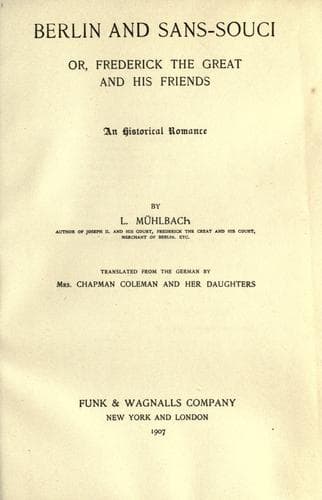
Berlin and Sans-Souci; Or, Frederick the Great and His FriendsMühlbach, L. (Luise)
History
Berlin and Sans-Souci; Or, Frederick the Great and His Friends
Mühlbach, L. (Luise)
Frederick II, King of Prussia, 1712-1786 -- Fiction; Prussia (Germany) -- History -- Frederick II, 1740-1786 -- Fiction
The noise of the horses' hoofs came nearer and nearer. The first
hussars have passed the king's tent, and two more, and again two,
and again, and again; and there in their midst, a pale young man,
with a distracted countenance, with staring eyes, and colorless
lips, which appear never to have known how to laugh, a young
officer, without sword or epaulettes. Is this Trenck, the beautiful,
the young, the light-hearted Trenck, the beloved of a princess, the
darling of all the ladies, the envied favorite of the king? He has
passed the tent of the king; behind him are his servants with his
horses and his baggage; and then again hussars, who close the
procession, the burial-procession of Trenck's happiness and freedom.
The king seemed deeply moved as he stepped back from the curtain.
"Now," he said solemnly, "I have committed my first act of
injustice; for I judged this man in my own conscience, without
bringing him before a court-martial. Should the world condemn me for
this, I can at least say that it is my only fault of the kind."
CHAPTER IX.
THE RETURN TO BERLIN.
Peace was proclaimed. This poor land, bleeding from a thousand
wounds, might now rest, in order to gather strength for new
victories. The husband of Maria Theresa had been crowned as emperor,
and the conditions of peace had been signed at Dresden, by both
Austrians and Prussians. The king and his army returned victorious
to their native land. Berlin had assumed her most joyous appearance,
to welcome her king; even Nature had done her utmost to enliven the
scene. The freshly fallen snow, which covered the streets and roofs
of the houses, glittered in the December sunshine as if strewn with
diamonds. But none felt to-day that the air was cold or the wind
piercing; happiness created summer in their hearts, and they felt
not that it was winter. On every side the windows were open, and
beautiful women were awaiting the appearance of their adored
sovereign with as much curiosity and impatience as the common people
in the streets, who were longing to greet their hero-king.
At length the happy hour came. At length the roar of cannon, the
ringing of bells, the shouts of the crowd, which filled every avenue
leading to the palace, announced that the king had returned to his
capital, which, in the last few days, he had saved by a happy
manoeuvre from being attacked by the Austrians and Saxons. The
people greeted their king with shouts; the ladies in the windows
waved their handkerchiefs, and threw fragrant flowers into the open
carriage in which Frederick and his brothers sat.
As they passed before the gymnasium, the scholars commenced a solemn
song, which was at the same time a hymn, and a prayer for their
king, their hero, and their father. "Vivat, vivat Fredericus! Rex
vivat, Augustus, Magnus, Felix Pater Patriae!" sang the scholars.
But suddenly rising above the voices of the singers, and the shouts
of the people, a voice was heard, crying aloud, "Vivat Frederick the
Great!"
Public-domain text, read in full here on John Shaqi.
Reviews
Reviews
No reviews yet
Be the first to share your thoughts on this work.
Elsewhere in the archive
Join the Discussion
Join the discussion
Sign in to leave a comment or review.
Sign InorCreate an account