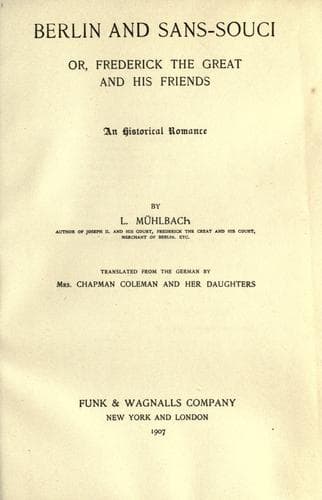
Berlin and Sans-Souci; Or, Frederick the Great and His FriendsMühlbach, L. (Luise)
History
Berlin and Sans-Souci; Or, Frederick the Great and His Friends
Mühlbach, L. (Luise)
Frederick II, King of Prussia, 1712-1786 -- Fiction; Prussia (Germany) -- History -- Frederick II, 1740-1786 -- Fiction
"Frederick the Great!" This cry still resounds through the streets,
and the windows of the palace tremble with the ringing of this proud
name. The sound enters the saloons before him; it opens wide the
doors of the White Saloon, and when the king enters, the pictures
and statues of the Hohenzollerns appear to become animate, the dead
eyes flash, the stiffened lips smile, and the motionless heads seem
to bow, for Frederick's new name has called his ancestors from their
graves--this name, which only one other Hohenzollern had borne
before him--this name, which is as rare a blossom on the
genealogical trees of the proudest royal families as the blossoms of
the aloe. The king greets his ancestors with a happy smile, for he
feels that he is no unworthy successor. He has forgotten his grief
and his pain; he has overcome them. In this hour he is only the king
and hero.
But as the shadows of night approach, and Berlin is brilliant with
illuminations, Frederick lays aside his majesty, and becomes once
more the loving man, the friend. He is sitting by the death-bed of
his friend and preceptor, Duhan. The joyous shouts of the people are
still heard without, but the king heeds them not; he hears only the
heavy breathing of his friend, and speaks to him gentle words of
love and consolation.
At length ho leaves his friend, and now a new light springs into his
eyes. He is no longer a king, no longer a mourning friend, he is
only a young man. He is going to spend an hour with his friend
General Rothenberg, and forget his royalty for a while.
Rothenberg seems to have forgotten it also, for he does not come to
welcome his kingly guest. He does not receive him on the threshold.
No one receives him, but the hall and stairway are brilliantly
lighted; and, as he ascends, a door opens, and a woman appears,
beautiful as an angel, with eyes beaming like stars, with lips
glowing as crimson roses. Is it an angel or a woman? Her voice is as
the music of the spheres to the king, when she whispers her welcome
to him, and he, at last, thinks he beholds an angel when he sees
Barbarina.
CHAPTER X.
JOB'S POST.
Berlin shouted, huzzaed, sang, danced, declaimed, illuminated for
three entire days in honor of the conquered peace, and the return of
her great king. Every one but the young Princess Amelia seemed
contented, happy, joyous. She took no part in the glad triumph of
her family, and the loud hosarmas of the people found no echo in her
breast. With heavy heart and misty eyes she walked slowly backward
and forward in her boudoir. For three days she had borne this
terrible torture, this anguish of uncertainty. Her soul was moved
with fearful anticipations, but she was forced to appear gay.
Public-domain text, read in full here on John Shaqi.
Reviews
Reviews
No reviews yet
Be the first to share your thoughts on this work.
Elsewhere in the archive
Join the Discussion
Join the discussion
Sign in to leave a comment or review.
Sign InorCreate an account