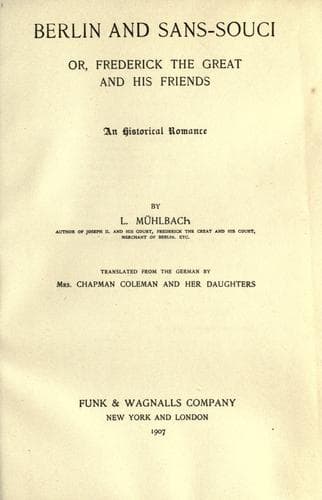
Berlin and Sans-Souci; Or, Frederick the Great and His FriendsMühlbach, L. (Luise)
History
Berlin and Sans-Souci; Or, Frederick the Great and His Friends
Mühlbach, L. (Luise)
Frederick II, King of Prussia, 1712-1786 -- Fiction; Prussia (Germany) -- History -- Frederick II, 1740-1786 -- Fiction
At other times it was a consolation to Eckhof to relate, in
passionate and eloquent words, all his sorrows and disappointments;
all the strifes and contests; all his scorn over the intrigues and
cabals which then, as now, were the necessary attendants of a stage-
life. Lupinus listened till this wild cataract of rage had ceased to
foam, and he might hope that his soft and loving words of
consolation could find an entrance into Eckhof's heart.
Months went by, and Lupinus, faithful to the promise given to
Eckhof, was still the thoughtful, diligent student; he sat ever in
quiet meditation upon the bench of the auditory, and listened to the
learned dissertations of the professors, and studied the secrets of
science in his lonely room.
But this time of trial was soon to be at an end. Eckhof agreed, that
after Lupinus had passed his examination, he should decide for
himself if he would abandon the glittering career of science for the
rough and stormy path of artist-life. In the next few days this
important event was to take place, and Lupinus would publicly and
solemnly receive his diploma.
Lupinus thought but little of this. He knew that the events of that
day must exercise an important influence upon his future, upon the
happiness or unhappiness of his whole life.
The day before the examination Lupinus was alone in his room. He
said to himself, "If the faculty give me my diploma, I will show
myself in my true form to Eckhof. I will step suddenly before him,
and in his surprise I will see if his friend Lupinus is more welcome
as--"
He did not complete the sentence, but blushing crimson at his own
thoughts, he turned away and took refuge in his books; but the
excitement and agitation of his soul were stronger than his will;
the letters danced and glimmered before his eyes; his heart beat
joyfully and stormily; and his soul, borne aloft on bold wings,
could no longer be held down to the dusty and dreary writing-desk;
he sprang up, threw the book aside, and hastened to the adjoining
room. No other foot had ever crossed the threshold of this still,
small room; it was always closed against the most faithful of his
friends.
Besides, this little bedroom concealed a mystery--a mystery which
would have excited the merriment of Fredersdorf and the wild
amazement of Eckhof. On the bed lay a vestment which seemed utterly
unsuited to the toilet of a young man; it was indeed a woman's
dress, a glistening white satin, such as young, fair brides wear on
their wedding-day. There, upon the table lay small white, satin
shoes, perfumed, embroidered pocket-handkerchiefs, ribbons, and
flowers. What did this signify? what meant this feminine boudoir,
next to the study of a young man? Was the beloved whom he wished to
adorn with this bridal attire concealed there? or, was this only a
costume in which he would play his first role as an actor?
Public-domain text, read in full here on John Shaqi.
Reviews
Reviews
No reviews yet
Be the first to share your thoughts on this work.
Elsewhere in the archive
Join the Discussion
Join the discussion
Sign in to leave a comment or review.
Sign InorCreate an account