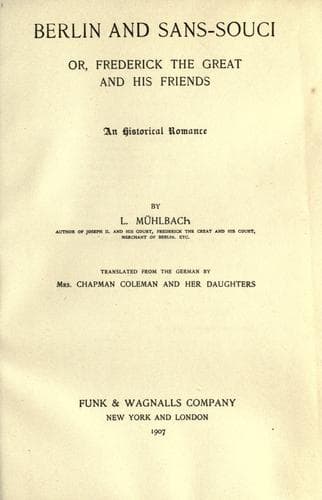
Berlin and Sans-Souci; Or, Frederick the Great and His FriendsMühlbach, L. (Luise)
History
Berlin and Sans-Souci; Or, Frederick the Great and His Friends
Mühlbach, L. (Luise)
Frederick II, King of Prussia, 1712-1786 -- Fiction; Prussia (Germany) -- History -- Frederick II, 1740-1786 -- Fiction
"Madame," said he, pointing to the papers which he held in his hand,
"from these papers I have undoubtedly learned what it was your
intention to have communicated to me. Your son has attempted to
escape from prison like a cowardly criminal, a malefactor weighed
down with guilt. In this attempt he has killed and wounded soldiers,
disarmed the governor of the fortress, and, in his insolent frenzy,
has endeavored to scale the palisades in broad daylight. Madame,
nothing but the consciousness of his own guilt could have induced
him to attempt so daring a flight, and he must have had criminal
accomplices who advised him to this step--accomplices who bribed the
sentinel on duty before his door; who secretly conveyed money to
him, and held horses in readiness for his flight. Woe to them if I
should ever discover the criminals who treasonably induced my
soldiers and officers to break their oath of fidelity!"
"I, your majesty, I was this criminal," said the countess. "A mother
may well dare to achieve the freedom of her son at any price. It is
her privilege to defend him with any weapon. I bribed the soldiers,
placed the horses in readiness, and conveyed money to my son. It was
Trenck's mother who endeavored to liberate him."
"And you have only brought him to greater, to more hopeless misery!
For now, madame, there can be no mercy. The fugitive, the deserter,
has forfeited the favor of his king. Shame, misery, and perpetual
captivity will henceforth be his portion. This is my determination.
Hope for no mercy. The articles of war condemn the deserter to
death. I will give him his life, but freedom I cannot give him, for
I now know that he would abuse it. Farewell."
"Mercy! mercy for my son!" sobbed the countess. "He is so young! he
has a long life before him."
"A life of remorse and repentance," said the king with severity. "I
will accord him no other. Go!"
He was on the point of reentering the library. A hand was laid on
his shoulder; he turned and saw the pale countenance of his sister.
"My brother," said the princess, in a firm voice, "permit me to
speak with you alone for a moment. Proceed, I will follow you."
Her bearing was proud, almost dictatorial. Her sternly tranquil
manner, her clear and earnest brow, showed plainly that she had
formed an heroic determination. She was no longer the young girl,
timidly praying for her lover; she was the fearless woman,
determined to defend him, or die for him. The king read this in her
countenance, it was plainly indicated in her royal bearing; and with
the reverence and consideration which great spirits ever accord to
misfortune, he did homage to this woman toward whom he was so
strongly drawn by sympathy and pity.
"Come, my sister, come," said he, offering his hand.
Public-domain text, read in full here on John Shaqi.
Reviews
Reviews
No reviews yet
Be the first to share your thoughts on this work.
Elsewhere in the archive
Join the Discussion
Join the discussion
Sign in to leave a comment or review.
Sign InorCreate an account