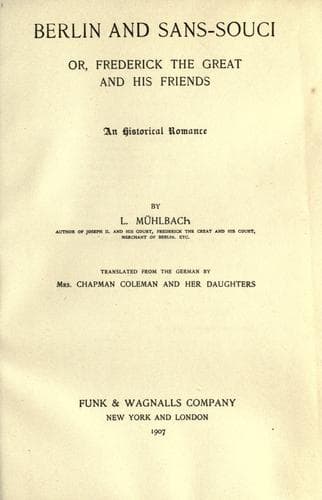
Berlin and Sans-Souci; Or, Frederick the Great and His FriendsMühlbach, L. (Luise)
History
Berlin and Sans-Souci; Or, Frederick the Great and His Friends
Mühlbach, L. (Luise)
Frederick II, King of Prussia, 1712-1786 -- Fiction; Prussia (Germany) -- History -- Frederick II, 1740-1786 -- Fiction
The king turned away with a sigh. He felt that if he longer regarded
this pale, resigned face, he would lose sight of reason and duty,
and restore to her her lover. He again advanced to the window, and
looked thoughtfully out at the sky. "Is it possible? can it be?" he
asked himself. "May I forget my duties as head of my family, and
only remember that she is my sister, and that she is suffering and
weeping? Must we then all pay for this empty grandeur, this frippery
of earthly magnificence, with our heart's blood and our best hopes?
And if I now deprive her of her dreams of happiness, what
compensation can I offer? With what can I replace her hopes, her
love, the happiness of her youth? At the best, with a little earthly
splendor, with the purple and the crown, and eventually, perhaps,
with my love. Yes, I will love her truly and cordially; she shall
forgive the brother for the king's harshness; she shall--"
"I have finished," said the sad voice of his sister.
The king turned from the window; Amelia stood at the escritoire,
holding the paper on which she had been writing in one hand, and
sustaining herself by the table with the other.
"Read what you have written," said the king, approaching her.
The princess bowed her head and read:
"I pity you, but your misfortune is irremediable; and I cannot and
will not attempt to alleviate it, for fear of compromising myself.
This is, therefore, my last letter--I can risk nothing more for you.
Do not attempt to write to me, for I should return your letter
unopened. Our separation must be forever, but I will always remain
your friend; and if I can ever serve you hereafter, I will do so
gladly. Farewell, unhappy friend, you deserve a better fate."
[Footnote: Trenck's Memoirs, i., 86.]
"That is all?" said the king, as his sister ceased reading.
"That is all, sire."
"And you imagine that he will no longer believe in your love, when
he receives this letter?" said the king, with a sad smile.
"I am sure he will not, for I tell him in this letter that I will
risk nothing more for him; that I will not even attempt to alleviate
his misery. Only when one is cowardly enough to sacrifice love to
selfish fears, could one do this. I shall have purchased his liberty
with his contempt."
"What would you have written if you had been permitted to follow the
promptings of your heart?"
A rosy hue flitted over her countenance, and love beamed in her
eyes. "I would have written, 'Believe in me, trust in me! For
henceforth the one aim of my life will be to liberate you. Let me
die when I have attained this aim, but die in the consciousness of
having saved you, and of having been true to my love.'"
"You would have written that?"
"I would have written that," said she, proudly and joyfully. "And
the truth of that letter he would not have doubted."
"Oh, woman's heart! inexhaustible source of love and devotion!"
murmured the king, turning away to conceal his emotion from his
sister.
Public-domain text, read in full here on John Shaqi.
Reviews
Reviews
No reviews yet
Be the first to share your thoughts on this work.
Elsewhere in the archive
Join the Discussion
Join the discussion
Sign in to leave a comment or review.
Sign InorCreate an account