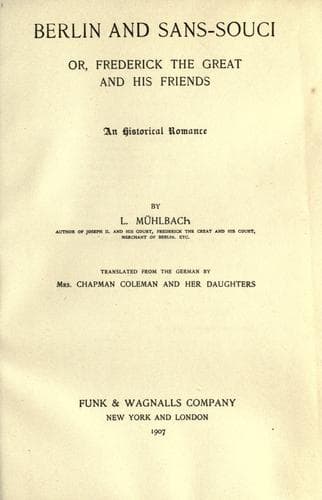
Berlin and Sans-Souci; Or, Frederick the Great and His FriendsMühlbach, L. (Luise)
History
Berlin and Sans-Souci; Or, Frederick the Great and His Friends
Mühlbach, L. (Luise)
Frederick II, King of Prussia, 1712-1786 -- Fiction; Prussia (Germany) -- History -- Frederick II, 1740-1786 -- Fiction
"The letters swim before my eyes in inextricable confusion. My God,
how hard it is to do one's duty!"
He rested his head on his hand, and was lost in thought for a long
time. Gradually his expression brightened, and a wondrous light
beamed in his eyes.
"Yes," said he, with a smile, "yes, so it shall be. I have just lost
a much-loved sister. Well, it is customary to erect a monument in
memory of those we love. Poor, lost sister, I will erect a monument
to your memory. The king has been compelled to make his sister
unhappy, and for this he will endeavor to make his people happy. And
if there is no law to which a princess can appeal against the king,
there shall at least be laws for all my subjects, which protect
them, and are in strict accordance with reason, with justice, and
the godly principle of equality. Yes, I will give my people a new
code of laws. [Footnote: Rodenbeck, Diary, p. 137.] This, Amelia,
shall be the monument which I will erect to you in my heart. In this
very hour I will write to Cocceji, and request him to sketch the
outlines of this new code of laws."
The king seized his pen and commenced writing. "The judges," said
he, hastily penning his words, "the judges must administer equal and
impartial justice to all without respect to rank or wealth, as they
expect to answer for the same before the righteous judgment-seat of
God, and in order that the sighs of the widows and orphans, and of
all that are oppressed, may not be visited upon themselves and their
children. No rescripts, although issued from this cabinet, shall be
deemed worthy of the slightest consideration, if they contain aught
manifestly incompatible with equity, or if the strict course of
justice is thereby hindered or interrupted; but the judges shall
proceed according to the dictates of duty and conscience."
The king continued writing, his countenance becoming more and more
radiant with pleasure, while his pen flew over the paper. He was so
completely occupied with his thoughts that he did not hear the door
open behind him, and did not perceive the merry and intelligent face
of his favorite, General Rothenberg, looking in.
The king wrote on. Rothenberg stooped and placed something which he
held in his arms on the floor. He looked over toward the king, and
then at the graceful little greyhound which stood quietly before
him. This was no other than the favorite dog of the king, which had
been lost and a captive. [Footnote: The greyhound had fallen into
the hands of the Austrians at the battle of Sohr, and had been
presented by General Nadasti to his wife as a trophy. When this lady
learned that Biche had been a pet of the king, she at first refused
to give it up: and only after several demands, and with much
difficulty, could she be induced to return it. Rodenbeck, Diary, p.
126.]
The little Biche stood still for a moment, looking around
intelligently, and then ran lightly across the apartment, sprang
upon the table and laid its forepaw on the king's neck.
Public-domain text, read in full here on John Shaqi.
Reviews
Reviews
No reviews yet
Be the first to share your thoughts on this work.
Elsewhere in the archive
Join the Discussion
Join the discussion
Sign in to leave a comment or review.
Sign InorCreate an account