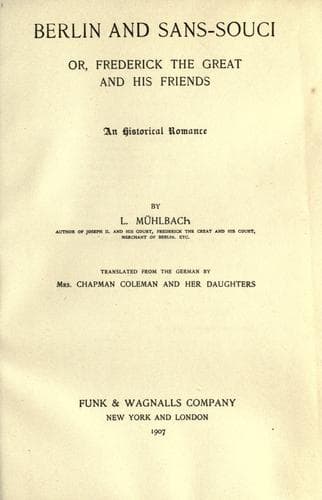
Berlin and Sans-Souci; Or, Frederick the Great and His FriendsMühlbach, L. (Luise)
History
Berlin and Sans-Souci; Or, Frederick the Great and His Friends
Mühlbach, L. (Luise)
Frederick II, King of Prussia, 1712-1786 -- Fiction; Prussia (Germany) -- History -- Frederick II, 1740-1786 -- Fiction
General Rothenberg bent over and whispered to Algarotti: "Barbarina
has wounded him; for some time past she has been sullen and
imperious. These haughty and powerful natures have been carrying on
an invisible war with each other; they both contend for
sovereignty."
"If this is so, I predict confidently that the beautiful Barbarina
will be conquered," said Algarotti. "Mankind will always be
conquered by Frederick the king, and must submit to him. So soon as
Frederick the Great recognizes the fact that the man in him is
subjected by the enchanting Barbarina, like Alexander the Great, he
will cut the gordian knot, and release himself from even the soft
bondage of love."
"I fear that he is strongly bound, and that the gordian knot of love
can withstand even the king's sword. Frederick, ordinarily so
unapproachable, so inexorable in his authority and self-control,
endures with a rare patience the proud, commanding bearing of
Barbarina. Even yesterday evening when the king did me the honor to
sup with me in the society of the Barbarina, in spite of her
peevishness and ever-changing mood, he was the most gallant and
attentive of cavaliers."
"And you think the king has not seen the signora since that time?"
"I do not know; let us ask the guard."
The gentlemen ascertained from the guard that Barbarina had left the
king's room in the morning, deadly pale, and with her eyes inflamed
by weeping.
"You see that I was right," said Algarotti; "this love-affair has
reached a crisis."
"In which I fear the king will come to grief," said Rothenberg.
"Believe me, his majesty loves Barbarina most tenderly."
"Not the king! the man loves Barbarina. But listen! did you not hear
a noise?"
"Yes, the low tone of a flute," said Fredersdorf. "Let us approach
the door."
Lightly and cautiously they stepped to the door, behind which the
king had carried on this fierce battle with himself, a battle in
which he had shed his heart's best blood. Again they heard the sound
of the flute: it trembled on the air like the last sigh of love and
happiness; sometimes it seemed like the stormy utterance of a strong
soul in extremest anguish, then melted softly away in sighs and
tears. Never in the king's gayest and brightest days had he played
with such masterly skill as now in this hour of anguish. The pain,
the love, the doubt, the longing which swelled his heart, found
utterance in this mournful adagio. Greatly moved, the three friends
listened breathlessly to this wondrous development of genius. The
king completed the music with a note of profound suffering.
Algarotti bowed to Rothenberg. "Friend," said he, "that was the last
song of the dying swan."
"God grant that it was the last song of love, not the death-song of
the king's heart! When a man tears love forcibly from his heart, I
am sure he tears away also a piece of the heart in which it was
rooted."
Public-domain text, read in full here on John Shaqi.
Reviews
Reviews
No reviews yet
Be the first to share your thoughts on this work.
Elsewhere in the archive
Join the Discussion
Join the discussion
Sign in to leave a comment or review.
Sign InorCreate an account