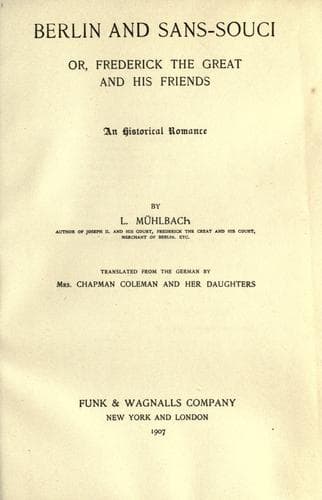
Berlin and Sans-Souci; Or, Frederick the Great and His FriendsMühlbach, L. (Luise)
History
Berlin and Sans-Souci; Or, Frederick the Great and His Friends
Mühlbach, L. (Luise)
Frederick II, King of Prussia, 1712-1786 -- Fiction; Prussia (Germany) -- History -- Frederick II, 1740-1786 -- Fiction
When Frederick entered Sans-Souci he laid aside all prejudices and
all considerations of rank. He wished to forget that he was king,
and desired his friends also to forget it, and to show him only that
consideration which is due to the man of genius and of letters. Some
of his friends had abused this privilege, and Frederick had been
forced to humiliate them. There were others who never forgot at
Sans-Souci the respect and reverence due to the royal house. Amongst
these was his ever-devoted, ever-uniform friend, the Marquis
d'Argens. He loved him, not because he was king, hut because he
believed him to be the greatest, best, most exalted of men. In the
midst of his brilliant court circle and all his earthly pomp,
D'Argens did not forget that Frederick was a man of letters, and his
dear friend; even so, while enjoying the hospitalities of Sans-
Souci, he remembered always that the genial scholar and gentleman
was a great and powerful king.
Frederick had the greatest confidence in D'Argens, and granted him
more privileges than any other of his friends. Frederick invited
many friends to visit him during the day, but the marquis was the
only guest whose bedchamber was arranged for him at Sans-Souci.
Four years have elapsed since D'Argens consecrated Weinberg--since
the day in which we closed our last chapter. We take advantage of
the liberty allowed to authors, and pass over these four years and
recommence our story in 1750, the year which historians are
accustomed to consider the most glorious and happy in the life of
Frederick the Second. We all know, alas! that earthly happiness
resembles the purple rose, which, even while rejoicing the heart
with her beauty and fragrance, wounds us with her thorns. We know
that the sunshine makes the flowers bloom in the gardens, on the
breezy mountains, and also on the graves; when we pluck and wear
these roses, who can decide if we are influenced by joy in the
present or sad remembrances of the past?
Frederick the Great appeared to be gay and happy, but these four
years had not passed away without leaving a mark upon his brow and a
shadow on his heart; his youthful smile had vanished, and the
expression of his lip was stern and resolved. He was now thirty-
eight years of age, and was still a handsome man, but the sunshine
of life had left him; his eyes could flash and threaten like Jove's,
but the soft and loving glance was quenched. Like Polycrates, King
Frederick, in order to propitiate fate, had sacrificed his idol. He
had thus lost his rarest jewel, had become poor in love. Perhaps his
crown rested more firmly upon his head, but his heart had received
an almost mortal wound; it had healed, but he was hardened!
Frederick thought not of the past four years, and their griefs and
losses, as he stood now upon the terrace of Sans-Souci, illuminated
by the evening sun, and gazed with ravished eyes upon the panorama
spread out before him.
Public-domain text, read in full here on John Shaqi.
Reviews
Reviews
No reviews yet
Be the first to share your thoughts on this work.
Elsewhere in the archive
Join the Discussion
Join the discussion
Sign in to leave a comment or review.
Sign InorCreate an account