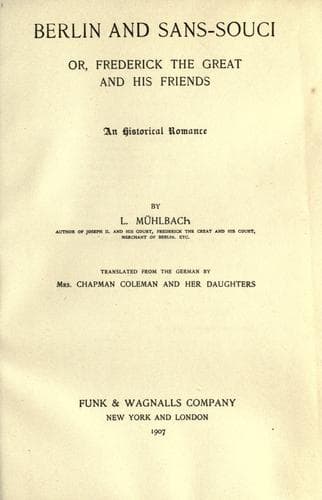
Berlin and Sans-Souci; Or, Frederick the Great and His FriendsMühlbach, L. (Luise)
History
Berlin and Sans-Souci; Or, Frederick the Great and His Friends
Mühlbach, L. (Luise)
Frederick II, King of Prussia, 1712-1786 -- Fiction; Prussia (Germany) -- History -- Frederick II, 1740-1786 -- Fiction
This friendship had no real foundation; it floated like a variegated
phantom in the air, a fata morgana, whose glittering temple halls
and pillars would soon melt away like the early cloud and the
morning dew. In these "cloud-capped towers and gorgeous palaces,"
the two great freethinkers and genial philosophers of their century
intended to cultivate and enjoy their friendship. In these temples
of air they wished to embrace each other, but the two-edged sword of
mistrust and suspicion already flashed between them, and both felt
inclined to draw back.
Both doubted the sincerity of this friendship, and the less they
believed in it the more eloquently they declaimed as to its ardor
and eternity. Each one thought to himself, "I will enjoy and profit
by the fruit of this friendship, I will yield up the blossoms only."
The blossoms, alas! were artificial, without odor and already
fading, though at the first glance they looked fresh and promising.
Once, in the youthful ardor of his enthusiasm for genius, Frederick
had forgotten himself so far as to kiss the hand of Voltaire.
[Footnote: Thiebault.] The proud and ambitious poet had boasted
loudly of this act of devotion; for this Frederick had never
forgiven him; he should have guarded it as a holy and dangerous
secret in the innermost shrine of his heart. Voltaire was angry with
the king because he had lately addressed some verses to the young
poet D'Arnaud, in which he was represented as the rising and
Voltaire as the setting sun. [Footnote: Oeuvres posthumes.] And yet
they believed they loved each other, and were about to put their
love to the severe test of uninterrupted intercourse.
The king awaited Voltaire with impatience, and now he heard the
rolling of carriage-wheels, then the opening of doors, then the
sound of voices. In the first impulse of joy he sprang from his seat
and advanced eagerly to meet Voltaire, but reaching the threshold of
the door ho stood still and considered. "No," said he, "I will not
go to meet him--he would mock at me, perhaps boast of it." He turned
back to Iris chair, and took up the book he had been reading. And
now some one tapped gently upon the door, a servant appeared and
announced "Monsieur Voltaire," and now a figure stood upon the door-
sill.
This man, with a small, contracted chest, with a back bowed down by
old age or infirmities; this man, with the wonderous countenance, of
which no one could decide if it was the face of a satyr or a demi-
god; whose eyes flashed with heavenly inspiration at one moment, and
in the next glowed with demoniac fire; whose lips were distorted by
the most frightful grimaces or relaxed into the most enchanting
smiles--this man is Voltaire.
Public-domain text, read in full here on John Shaqi.
Reviews
Reviews
No reviews yet
Be the first to share your thoughts on this work.
Elsewhere in the archive
Join the Discussion
Join the discussion
Sign in to leave a comment or review.
Sign InorCreate an account