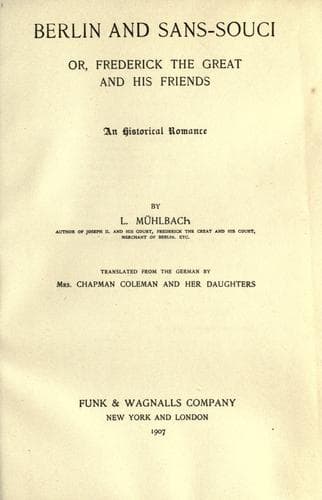
Berlin and Sans-Souci; Or, Frederick the Great and His FriendsMühlbach, L. (Luise)
History
Berlin and Sans-Souci; Or, Frederick the Great and His Friends
Mühlbach, L. (Luise)
Frederick II, King of Prussia, 1712-1786 -- Fiction; Prussia (Germany) -- History -- Frederick II, 1740-1786 -- Fiction
'Deja sans etre temeraire,
Prenant votre vol jusqu'aux cieux,
Vous pouvez egaler Voltaire,
Et pres de Virgile et d'Homere.
Jouir de vos succes heureux,
Deja l'Apollon de la France,
S'achemine a sa decadence,
Venez briller a votre tour,
Elevez vous s'il brille encore;
Ainsi le couchant d'un beau jour,
Promet une plus belle aurore.'
[Footnote: Supplement des Oeuvres Posthumes.]
"Yes," said the king, as Voltaire ceased declaiming, and stood in
rather a tragic attitude before him--"yes, I confess that a
sensitive nature like yours might find a thorn in these innocent
rhymes. My only intention was to give to the little Arnaud a few
roses which he might weave into a wreath of fame. It seems I
fulfilled my purpose poorly; it was high time that Voltaire should
come to teach me to make better verses. See, I confess my injustice,
and I allow you to punish me by writing a poem against me, which
shall be published as extensively as my little verse to Arnaud."
"Does your majesty promise me this little revenge in earnest?"
"I promise it; give me your poem as soon as it is ready; it shall be
published in 'Formey's Journal.'"
"Sire, it is ready: hear it now. [Footnote: Oeuvres Completes de
Voltaire.]
"'Quel diable de Marc Antoine!
Et quelle malice est le votre,
Vous egratinez d'une main
Lorsque vous caressez de l'autre.'"
"Ah," said Frederick, "what a beautiful quatrain Monsieur Arouet has
made."
"Arouet!" said Voltaire, astonished,
"Well, now, you would not surely wish me to believe that this little
stinging, pitiful rhyme, was written by the great Voltaire. No, no!
this is the work of the young Arouet, and we will have it published
with his signature."
Voltaire fixed his great eyes for a moment angrily upon the handsome
face of the king, then bowed his head and looked down thoughtfully.
There was a pause, and his face assumed a noble expression--he was
again the great poet.
"Sire," said he, softly, "I will not have this poem published. You
are right, Voltaire does not acknowledge it. This poor verse was
written by Arouet, or the 'old Adam,' who often strikes the poet
Voltaire slyly in the back. But you, sire, who have already won five
battles, and who find a few morning hours sufficient to govern a
great kingdom with wisdom, consideration, and love; you, by one
kindly glance of your eye, will be able to banish the old Adam, and
call heavenly hymns of love and praise from the lips of Voltaire."
"I shall be content with hymns of love. I will spare you all
eulogy," cried Frederick, giving his hand warmly to Voltaire.
At the close of the first day at Sans-Souci, the new gentleman of
the bedchamber returned to Potsdam, adorned with the order "Pour le
merite," and a written assurance from the king of a pension of five
thousand thalers in his pocket.
Public-domain text, read in full here on John Shaqi.
Reviews
Reviews
No reviews yet
Be the first to share your thoughts on this work.
Elsewhere in the archive
Join the Discussion
Join the discussion
Sign in to leave a comment or review.
Sign InorCreate an account