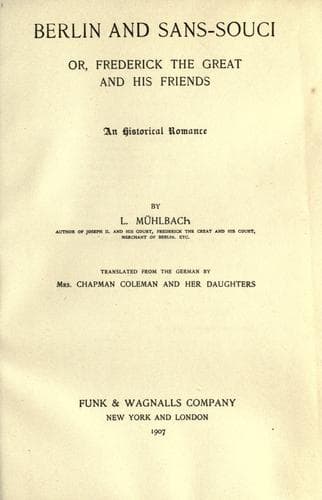
Berlin and Sans-Souci; Or, Frederick the Great and His FriendsMühlbach, L. (Luise)
History
Berlin and Sans-Souci; Or, Frederick the Great and His Friends
Mühlbach, L. (Luise)
Frederick II, King of Prussia, 1712-1786 -- Fiction; Prussia (Germany) -- History -- Frederick II, 1740-1786 -- Fiction
"It shall live," cried the king, "and we will each one honor this,
our first sitting, by showing our confidence in each other. Every
one shall relate something piquant and strange of his past life,
some lively anecdote, or some sweet little mystery which we dare
trust to our friends, but not to our wives. The oldest begins
first."
"I am afraid I am that," said Voltaire, "but your majesty must
confess that my heart has neither white hair nor wrinkles. Old age
is a terrible old woman who slides quietly, grinning and
threatening, behind every man, and watches the moment when she dares
lay upon him the mask of weary years through which he has lived and
suffered. She has, alas! fastened her wrinkled mask upon my face,
but my heart is young and green, and if the women were not so short-
sighted as to look only upon my outward visage, if they would
condescend to look within, they would no longer call me the old
Voltaire, but would love and adore me, even as they did in my
youth."
"Listen well, friends, he will no doubt tell us of some duchess who
placed him upon an altar and bowed down and worshipped him."
"No, sire, I will tell you of an injury, the bitterest I ever
experienced, and which I can never forget."
"As if he had ever forgotten an injury, unless he had revenged it
threefold!" cried D'Argens.
"And chopped up his enemy for pastry and eaten him," said La
Mettrie.
"Truly, if I should eat all my enemies, I should suffer from an
everlasting indigestion, and, in my despair, I might fly to La
Mettrie for help. It is well known that when you suffer from
incurable diseases, you seek, at last, counsel of the quack."
"You forget that La Mettrie is a regular physician," said the king,
with seeming earnestness.
"On the contrary, he remembered it well," said La Mettrie, smiling.
"The best physician is the greatest quack, or the most active grave-
digger, if you prefer it."
"Silence!" said the king. "Voltaire has the floor; he will tell us
of the greatest offence he ever received. Give attention."
"Alas! my heart is sad, sire; of all other pain, the pain of looking
back into the past is the most bitter. I see myself again a young
man, the Arouet to whom Ninon de l'Enclos gave her library and a
pension, and who was confined for twenty years to the Bastile
because he loved God and the king too little, and the charming
Marquise de Villiers and some other ladies of the court too much.
Besides these exalted ladies, there was a beautiful young maiden
whom I loved--perhaps because she had one quality which I had never
remarked in the possession of my more noble mistresses--she was
innocent! Ah, friends, you should have seen Phillis, and you would
have confessed that no rose-bud was lovelier, no lily purer, than
she. Phillis was the daughter of a gypsy and a mouse-catcher, and
danced on the tight-rope in the city-gardens."
Public-domain text, read in full here on John Shaqi.
Reviews
Reviews
No reviews yet
Be the first to share your thoughts on this work.
Elsewhere in the archive
Join the Discussion
Join the discussion
Sign in to leave a comment or review.
Sign InorCreate an account