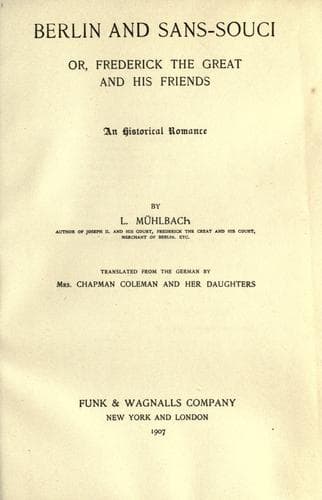
Berlin and Sans-Souci; Or, Frederick the Great and His FriendsMühlbach, L. (Luise)
History
Berlin and Sans-Souci; Or, Frederick the Great and His Friends
Mühlbach, L. (Luise)
Frederick II, King of Prussia, 1712-1786 -- Fiction; Prussia (Germany) -- History -- Frederick II, 1740-1786 -- Fiction
The reader has learned, from the foregoing chapters, what a splendid
role the French theatre and ballet were now playing at the court of
Berlin. A superb house had been built for the Italian opera and the
ballet, a stage had been prepared in the king's palace for the
French comedies, and every representation was honored by the
presence of the king, the royal family, and the court circle. The
most celebrated singers of Italy, the most graceful Parisian dancers
were now to be heard and seen in Berlin. These things assumed such
vast importance, that the king himself appeared as a critic in the
daily journals, and his articles were published in the foreign
papers. While the king favored the strange actors with his presence
and his grace, the German theatre, like a despised step-child, was
given over to misery and contempt. Compelled to seek an asylum in
low dark saloons, its actors had to be thankful for even the
permission to exist, and to plead with Apollo and the Muses for aid
and applause. The king and the so-called good society despised them
altogether. But this step-child carried under her ashes and ragged
garments the golden robes of her future greatness; her cunning step-
sisters had cast her down into obscurity and want, but she was not
extinguished; she could not be robbed of her future! Only a few
propitious circumstances were necessary to enable her to shake the
dust from her head, and bring her kingly crown to light.
The king had given Schonemein permission to bring his company to
Berlin; and by a happy chance, Schonemein had engaged the young and
talented actor Eckhof for the season. Eckhof was destined to give
renown to the German theatre; he was justly called the first and
greatest actor in Germany. Alas, how much of misery, how much of
humiliation, how many choking tears, how much suffering and care,
how much hunger and thirst were then comprised in that one word, a
"German actor!" None but a lost or despairing man, or an enthusiast,
would enroll himself as a German actor; only when he had nothing
more to lose, and was willing to burn his ships behind him, could he
enter upon that thorny path. Religion and art have always had their
martyrs, and truly the German actors were martyrs in the time of
Frederick the Great. Blessings upon those who did not despair, and
took up their cross patiently!
The French comedy and the Italian opera flourished like the green
bay-tree. The German actors took refuge in the saloon of the
Council-house. The lighting up of the Royal Opera-house cost two
hundred and seventy-seven florins every night. The misty light of
sweltering oil lamps illuminated the poor saloon of the Council-
house.
Public-domain text, read in full here on John Shaqi.
Reviews
Reviews
No reviews yet
Be the first to share your thoughts on this work.
Elsewhere in the archive
Join the Discussion
Join the discussion
Sign in to leave a comment or review.
Sign InorCreate an account