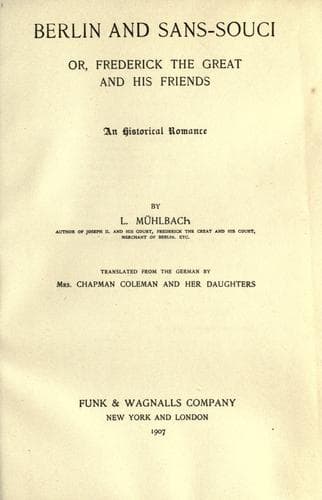
Berlin and Sans-Souci; Or, Frederick the Great and His FriendsMühlbach, L. (Luise)
History
Berlin and Sans-Souci; Or, Frederick the Great and His Friends
Mühlbach, L. (Luise)
Frederick II, King of Prussia, 1712-1786 -- Fiction; Prussia (Germany) -- History -- Frederick II, 1740-1786 -- Fiction
The audience of the German theatre was composed of burghers,
philosophers, poets, bankers, and clerks--the people of the middle
classes, who wore no white plumes in their hats; they were indeed
allowed to enter the opera-house, but through a side passage, and
their boxes were entirely separated from those of the court circle.
These people of the middle classes seemed obscure and unimportant,
but they were educated and intelligent; even then they were a power;
proud and independent, they could not be bribed by flattery, nor
blinded by glitter and pomp. They judged the king as they judged the
beggar, the philosopher as they did the artist, and they judged
boldly and well.
This public voice had declared that Eckhof was a great tragedian,
who rivalled successfully the great French actor, Monsieur Dennis.
This public voice, though but the voice of the people, found
entrance everywhere, even in the saloons of the nobles and cabinets
of princes. Berlin resounded with the name of Eckhof, who dared to
rival the French actor, and with the name of Schonemein, who dared,
every time a drama of Corneille or Racine, of Moliere or Voltaire,
was given in the palace theatre, to represent the same in the
Council-house on the following evening. This was a good idea. Those
who had been so fortunate as to witness the performance at the
palace, wished to compare the glittering spectacle with the poor
caricature, as they were pleased to call it, in the Council-house.
Those whose obscure position prevented them from entering the French
theatre, wished at least to see the play which had enraptured the
king and court; they must be content with a copy, somewhat like the
hungry beggar who stands before the kitchen door, and refreshes
himself by smelling the roast beef he cannot hope to taste. But
there was still a third class who visited the German theatre, not in
derision, not from curiosity, not from a desire to imitate the
nobles in their amusements, but with the seemingly Utopian hope of
building up the German drama. Amongst these were the scholars, who
pronounced the dramas of Gottsched far superior to those of
Corneille and Racine; there were the German patriots, who would not
grant a smile to the best representation of "Le Malade Imaginaire,"
but declared "The Hypochondriac," by Guistorp, the wittiest drama in
the world. In short, this large class of men ranged themselves in
bold opposition to the favoritism shown to Frenchmen by Frederick
the Great. These were the elements which composed the audience in
the Council-house.
Public-domain text, read in full here on John Shaqi.
Reviews
Reviews
No reviews yet
Be the first to share your thoughts on this work.
Elsewhere in the archive
Join the Discussion
Join the discussion
Sign in to leave a comment or review.
Sign InorCreate an account