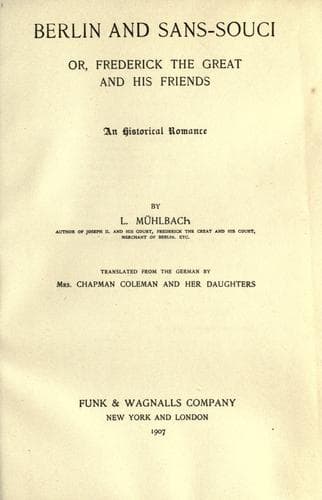
Berlin and Sans-Souci; Or, Frederick the Great and His FriendsMühlbach, L. (Luise)
History
Berlin and Sans-Souci; Or, Frederick the Great and His Friends
Mühlbach, L. (Luise)
Frederick II, King of Prussia, 1712-1786 -- Fiction; Prussia (Germany) -- History -- Frederick II, 1740-1786 -- Fiction
"I fear," said the youth. "your science is beyond my ability. I have
no organ for it. My father is a celebrated physician in Quedlinburg;
he would be greatly distressed if I should occupy myself with any
thing else than philosophy and the arts. I myself have so little
inclination and so little ability for the enjoyment of mirth and
pleasure, that I dare not exchange the world of books for the world
of men. I do not understand their speech, and their manners are
strange to me."
"But, without doubt, you have come to Berlin to learn something of
these things?"
"No, I have come to visit the medical college, and to speak with the
learned and renowned Euler."
"Folly and nonsense!" said Fredersdorf, laughing; "keep your dry
pursuits for Halle, and give your time and attention to that which
you cannot find there, gayety and amusement. I promise to be your
counsellor and comrade. Let us begin our studies at once. Do you see
that little theatre-bill fastened to the wall? Eckhof appears as
Cato to-night."
"Go to the theatre!" said Lupinus, shrinkingly. "How! I go to the
theatre?"
"And why not, friend?" said Joseph. "Perhaps you belong to the
pietists, who look upon the stage as the mother of blasphemy and
sin, and who rail at our noble king because he will not close these
houses?"
"No, I do not belong to the pietists," said the youth, with a sad
smile, "and I try to serve God, by understanding and admiring His
works: that is my religion."
"Well, it seems to me that this faith does not forbid you to enter
the theatre. If it pleases you to study God's master-work, I promise
to show you this night on the stage the noblest exemplar. Eckhof
plays this evening."
"Who, then, is Eckhof?"
Joseph looked at the young man with surprise, and shrugged his
shoulders contemptuously.
"You have, indeed, been greatly neglected, and it was high time you
should come to me. You do not know, then, that Eckhof is the first
tragedian who has dared to set aside the old and absurd dress and
manners of the stage, and introduce real, living, feeling men, of
like passions with ourselves, and who move and speak even as we do.
Now we must certainly enter the theatre; look there, at that great
crowd entering the dark and lowly entrance. Let us remove our hats
reverentially; we stand before the temple of art." So saying, he
drew the young man, who had no longer courage to resist, into the
house. "This is Eckhof's benefit. You see the great tragedian has
many admirers; it seems to me that half of Berlin has come to bring
him tribute this evening."
Public-domain text, read in full here on John Shaqi.
Reviews
Reviews
No reviews yet
Be the first to share your thoughts on this work.
Elsewhere in the archive
Join the Discussion
Join the discussion
Sign in to leave a comment or review.
Sign InorCreate an account