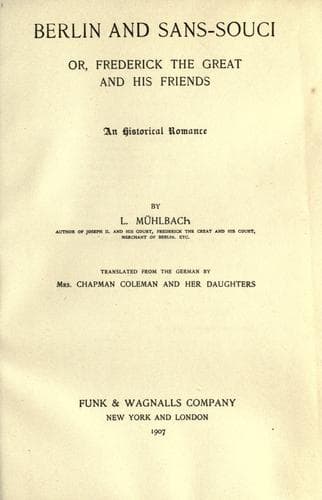
Berlin and Sans-Souci; Or, Frederick the Great and His FriendsMühlbach, L. (Luise)
History
Berlin and Sans-Souci; Or, Frederick the Great and His Friends
Mühlbach, L. (Luise)
Frederick II, King of Prussia, 1712-1786 -- Fiction; Prussia (Germany) -- History -- Frederick II, 1740-1786 -- Fiction
Fredersdorf had not the courage to reply. The king stepped hastily
through the room and opened the tapestry door; as he stood upon the
threshold, he turned once again. "Fredersdorf, the time will come
when you will thank me for having been a stern king." He closed the
door, placed the key in his pocket, and returned to his room, where
Jordan awaited him.
"And now, friend, the police may act promptly and rigorously;
Fredersdorf will not be there, and I shall not find it necessary to
punish him further. Alas! how difficult it is to turn a fool from
his folly! Fredersdorf would learn to make gold through the
sacrifice of a black ram; in order to do this, he joins himself to
my adversaries, to the hypocrites and pietists; he goes to the so-
called prayer-meetings of the godless, who call themselves,
forsooth, the children of God! Ah! Jordan, how selfish, how pitiful
is this small race of man! how little do they merit! I took
Fredersdorf from obscurity and poverty. I not only took him into my
service, I made him my confidant and my friend--I loved him
sincerely. And what is my reward? He is ungrateful, and he hates me
with a perfect hatred; he is now sitting in his room and cursing his
king, who has done nothing more than protect him from the withering
ridicule which his childish and mad pursuit was about to bring upon
him. Jordan, Jordan! kings are always repaid with ingratitude."
"Yes, sire; and God, our heavenly Father, meets with the same
reward," said Jordan, with a painful smile. "God and the king are
the two powers most misunderstood. In their bright radiance they
stand too high above the sons of men: they demand of the king that
he shall be all-wise, almighty, even as God is; they require of God
that He shall judge and act as weak, short-sighted men do, not
'knowing the end from the beginning.'"
The king did not reply; with his arms folded, he walked thoughtfully
through the room.
"Poor Fredersdorf," said he, softly, "I have slain his hobby-horse,
and that is always an unpardonable offence to any man. I might,
perhaps, have closed my eyes to the mad follies of these so-called
pietists, if they had not drawn my poor secretary into the toils.
For his sake I will give them a lesson. I will force him to see that
they are hypocrites and charlatans. Happen what will, I have saved
Fredersdorf from ridicule; if he curses me for this, I can bear it
cheerfully."
The king was right; Fredersdorf was insane with passion. He cursed
the king, not only in his heart, but with his trembling lips; he
called him a tyrant, a heartless egotist. He hated him, even as an
ignorant, unreasoning child hates the kind hand which corrects and
restrains.
Public-domain text, read in full here on John Shaqi.
Reviews
Reviews
No reviews yet
Be the first to share your thoughts on this work.
Elsewhere in the archive
Join the Discussion
Join the discussion
Sign in to leave a comment or review.
Sign InorCreate an account