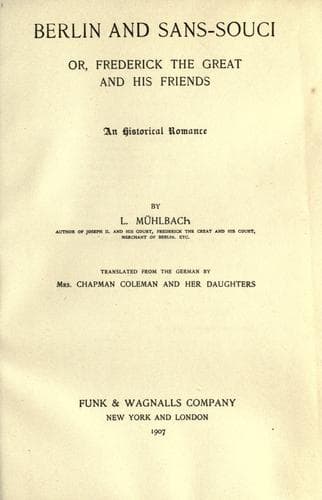
Berlin and Sans-Souci; Or, Frederick the Great and His FriendsMühlbach, L. (Luise)
History
Berlin and Sans-Souci; Or, Frederick the Great and His Friends
Mühlbach, L. (Luise)
Frederick II, King of Prussia, 1712-1786 -- Fiction; Prussia (Germany) -- History -- Frederick II, 1740-1786 -- Fiction
"Why should I deny it? I accept this crown which you cast from you
with contempt. I am ambitious. You were too proud to offer up the
smallest part of your religious faith in order to mount the throne
of Sweden. I do not fear to be banished from heaven, because, in
order to become a queen, I changed the outward form of my religion;
my inward faith is unchanged: if you repent your conduct--if you
have modified your views--"
"No, no!" said Amelia, hastily, "I do not repent. My grief and my
despair are not because of this pitiful crown, but because of my
faithless and deceitful sister who gave me evil counsel to promote
her own interests, and while she seemed to love, betrayed me. Go,
go! place a crown upon your proud head; you take up that which I
despise and trample upon. I do not repent. I have no regrets. But,
hark! in becoming a queen, you cease to be my sister. Never will I
forget that through falsehood and treachery you won this crown. Go!
be Queen of Sweden. Let the whole world bow the knee before you. I
despise you. You have shrouded your pitiful heart in your royal
robes. Farewell!"
She sprang to the door with flashing eyes and throbbing breast, but
Ulrica followed and laid her hand upon her shoulder.
"Let us not part in anger, my sister," said she, softly--"let us--"
Amelia would not listen; with an angry movement she dashed the hand
from her shoulder and fled from the room. Alone in her boudoir, she
paced the room in stormy rage, wild passion throbbed in every pulse.
With the insane fury of the Hohenzollerns, she almost cursed her
sister, who had so bitterly deceived, so shamefully betrayed her.
In outward appearance, as well as in character, the Princess Amelia
greatly resembled her royal brother: like him, she was by nature
trusting and confiding; but, once deceived, despair and doubt took
possession of her. A deadly mildew destroyed the love which she had
cherished, not only for her betrayer, but her confidence and trust
in all around her. Great and magnanimous herself, she now felt that
the rich fountain of her love and her innocent, girlish credulity
were choked within her heart. With trembling lips, she said aloud
and firmly: "I will never more have a friend. I do not believe in
friendship. Women are all false, all cunning, all selfish. My heart
is closed to them, and their deceitful smiles and plausible words
can never more betray me. Oh, my God, my God! must I then be always
solitary, always alone? must I--"
Suddenly she paused, and a rich crimson blush overspread her face.
What was it which interrupted her sorrowful words? Why did she fix
her eyes upon the door so eagerly? Why did she listen so earnestly
to that voice calling her name from the corridor.
"Pollnitz, it is Pollnitz!" she whispered to herself, and she
trembled fearfully.
"I must speak with the Princess Amelia," cried the master of
ceremonies.
Public-domain text, read in full here on John Shaqi.
Reviews
Reviews
No reviews yet
Be the first to share your thoughts on this work.
Elsewhere in the archive
Join the Discussion
Join the discussion
Sign in to leave a comment or review.
Sign InorCreate an account