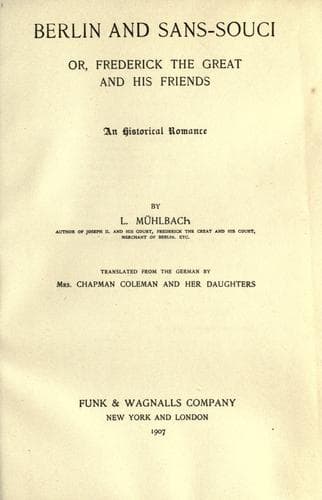
Berlin and Sans-Souci; Or, Frederick the Great and His FriendsMühlbach, L. (Luise)
History
Berlin and Sans-Souci; Or, Frederick the Great and His Friends
Mühlbach, L. (Luise)
Frederick II, King of Prussia, 1712-1786 -- Fiction; Prussia (Germany) -- History -- Frederick II, 1740-1786 -- Fiction
"The fortress is ready to surrender," cried he; "advance and storm
it, and you will enter the open door of the heart as conqueror. I
have prepared the way for you to see the princess every day: make
use of your opportunities like a brave, handsome, young, and loving
cavalier. I predict you will soon be a general, or a prince, or
something great and envied."
"A general, a prince, or a high traitor, who must lay his head upon
the block and expiate his guilt with his life," said Trench
thoughtfully. "Let it be so. In order to become this high traitor, I
must first be the happiest, the most enviable of men. I shall not
think that too dearly paid for by my heart's blood. Oh, Amelia,
Amelia! I love thee boundlessly; thou art my happiness, my
salvation, my hope; thou--"
"Enough, enough!" said Pollnitz, laughing and placing his hands upon
his ears. "These are well-known, well-used, and much-abused phrases,
which have been repeated in all languages since the time of Adam,
and which after all are only lovely and fantastic lies. Act, my
young friend, but say nothing; you know that walls have ears. The
table upon which you write your letters, and the portfolio in which
you place the letters of the princess, to be guarded to all
eternity, both have prying eyes. Prudence, prudence! burn the
letters of the princess, and write your own with sympathetic ink or
in cipher, so that no man can read them, and none but God and the
devil may know your dangerous secret."
Trenck did not hear one word of this; he was too happy, too
impassioned, too young, to listen to the words of warning and
caution of the old roue. He read again and again, and with ever-
increasing rapture, the letter of the princess; he pressed it to his
throbbing heart and glowing lips, and fixed his loving eyes upon
those characters which her hand had written and her heart had
dictated.
Pollnitz looked at him with a subdued smile, and enjoyed his
raptures, even as the fox enjoys the graceful flappings of the
wings, the gentle movements of the dove, when he knows that she
cannot escape him, and grants her a few moments of happiness before
he springs upon and strangles her. "I wager that you know that
letter by heart," said he, as he slowly lighted a match in order to
kindle his cigar; "am I not right? do you not know it by heart?"
"Every word is written in letters of flame upon my heart."
With a sudden movement, the baron snatched the paper from the young
man and held it in the flames,
"Stop! stop!" cried Frederick von Trenck, and he tried to tear the
letter from him.
Pollnitz kept him off with one arm and waved the burning paper over
his head.
"My God! what have you done?" cried the young man.
"I have made a sacrifice to the god of silence," said he solemnly;
"I have burnt this paper lest it might be used to light the scaffold
upon which you may one day burn as a high traitor. Thank me, young
man. I have perhaps saved you from discovery and from death."
CHAPTER III.
Public-domain text, read in full here on John Shaqi.
Reviews
Reviews
No reviews yet
Be the first to share your thoughts on this work.
Elsewhere in the archive
Join the Discussion
Join the discussion
Sign in to leave a comment or review.
Sign InorCreate an account