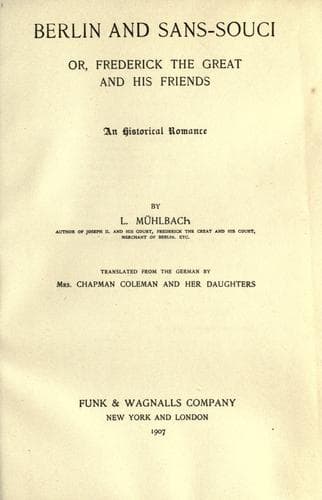
Berlin and Sans-Souci; Or, Frederick the Great and His FriendsMühlbach, L. (Luise)
History
Berlin and Sans-Souci; Or, Frederick the Great and His Friends
Mühlbach, L. (Luise)
Frederick II, King of Prussia, 1712-1786 -- Fiction; Prussia (Germany) -- History -- Frederick II, 1740-1786 -- Fiction
Perhaps these costly and magnificent wedding festivities which would
have been prepared for her, had she not refused a husband worthy of
her birth, aroused her anger, and in her rage and her despair she
entered upon dangerous paths, and fell into the cruel snares of
Pollnitz. She said to herself: "Yes, all this honor and glory was my
own, but my weak heart and my perfidious sister wrenched them from
my grasp. Fate offered me a way of escape, but my sister cast me
into the abyss in which I now stand; upon her rests the
responsibility. Upon her head be my tears, my despair, my misery,
and my shame. Ulrica prevented me from being a queen; well, then, I
will be simply a young girl, who loves and who offers up all to her
beloved, her pride, her rank, and the unstained greatness of her
ancestors. For Ulrica be honor, pomp, and power; for me the mystery
of love, and a girl's silent happiness. Who can say which of us is
most to be envied?"
These were indeed happy, sunny days, which were prepared for the
bride of Adolph Frederick of Holstein, the Crown Prince of Sweden.
Fete succeeded to fete. The whole land took part in the happiness of
the royal family. All the provinces and cities sent deputations to
congratulate the king, and bring rich gifts to the princess; she who
had been always cast into the shade by the more noble and
bewildering beauty of her younger sister, had now become the centre
of attraction in all these superb festivities which followed each
other in quick succession. It was in honor of the Princess Ulrica
that the king gave a masked ball in the opera-house, to which the
whole city was invited; for her, on the evening of her betrothal,
every street in Berlin was brilliantly illuminated with wax-lights,
not by command of the king, but as a free-will offering of the
people; for her the queen, at Schonhausen, gave a superb ball; for
her the Swedish ambassador arranged a fete, whose fabulous pomp and
extravagant luxury were supposed to indicate the splendor which
awaited her in her new home. Lastly, this ball at the royal palace,
to which not only the nobles, but many of the wealthy burghers were
invited, was intended as a special compliment to Ulrica.
More than three thousand persons moved gayly through these royal
saloons, odorous with the perfume of flowers, glittering with wax-
lights, the glimmer of diamonds, and rich gold and silver
embroideries--nothing was to be seen but ravishing toilets and happy
faces. All the beauty, youth, rank, fame, and worth of Berlin were
assembled at the palace; and behind these lovely ladies and
glittering cavaliers, the wondering, gaping crowd, of common men,
moved slowly onward, dumb with amazement and delight. The king had
commanded that no well-dressed person should be denied entrance to
the castle.
Public-domain text, read in full here on John Shaqi.
Reviews
Reviews
No reviews yet
Be the first to share your thoughts on this work.
Elsewhere in the archive
Join the Discussion
Join the discussion
Sign in to leave a comment or review.
Sign InorCreate an account