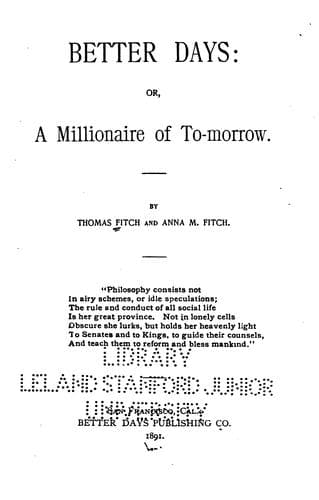
Better days; or, A Millionaire of To-morrowFitch, Thomas
Philosophy
Better days; or, A Millionaire of To-morrow
Fitch, Thomas
Utopias -- Fiction; West (U.S.) -- Fiction
“The Court can not only pardon your emphatic language, Brother Bruff,”
said his Honor, “but indorses it. If I could discover any loophole which
might be crawled through, or any way by which I could break down or
climb over the legislative barrier, and validate the bequest of Lorin
French, I would certainly do so. I will reserve for further
consideration the question of the validity of the legacies to the
wounded, and the families of those killed in the riot. I am inclined to
think that portion of the will may be good, and so carry with it the
right of Louis Browning to letters testamentary. For the present,
however, I am reluctantly compelled to sustain the objection of the
attorney for the public administrator, and refuse the will admission to
probate. It is ordered accordingly. Mr. Clerk, note the exception of Mr.
Bruff to my ruling. I will take my summer vacation now, and go fishing.
I shall adjourn court for one month, and the further hearing of this
case for two months. In the meantime, if the gentlemen who represent the
various applicants for letters of administration, will leave their
papers with the clerk, I will, upon my return, give them careful
attention.”
“Does your Honor desire that I leave all my papers?” queried the
sepulchral-voiced Lester.
“All,” replied his Honor and he paused for a moment, and glanced at the
ninety pages of manuscript lying in front of counsel learned in the law,
“all except your brief, Mr. Lester.”
The proceedings of the day in the superior court were reported fully,
and commented upon freely, by the newspapers throughout the country, and
a fortnight afterwards the proposed executor of the rejected will
received the following letter:—
OFFICES OF DAVID MORNING, 39 Broadway, }
New York City, June 10, 1894. }
MR. LOUIS BROWNING, San Francisco, Cal.—_My Dear Sir_: Such a wise and
noble plan as that of the late Lorin French ought not to lack
accomplishment for want of money to execute it. If you, and the
gentlemen named by him as your associates in the trust which he vainly
endeavored to create, will organize such a corporation as he proposed,
I will devote to it a sum equal to the value of his estate, which I
understand to be, in round numbers, twenty millions of dollars.
Very truly yours, DAVID MORNING.
CHAPTER XVI.
“The conscience of well doing is an ample reward.”
[From the _New York World_, July 15, 1895.]
Public-domain text, read in full here on John Shaqi.
Reviews
Reviews
No reviews yet
Be the first to share your thoughts on this work.
Elsewhere in the archive
Join the Discussion
Join the discussion
Sign in to leave a comment or review.
Sign InorCreate an account