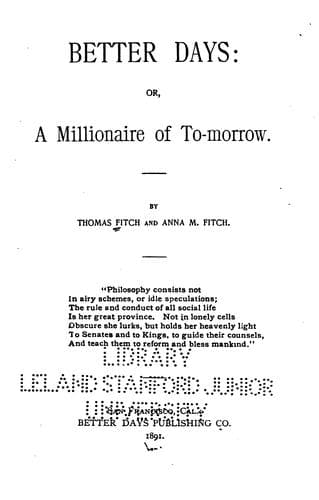
Better days; or, A Millionaire of To-morrowFitch, Thomas
Philosophy
Better days; or, A Millionaire of To-morrow
Fitch, Thomas
Utopias -- Fiction; West (U.S.) -- Fiction
The alternative is to bring up his family in the brawl and small scandal
of a boarding house. His wife requires always a certain amount of
dresses and bonnets to maintain herself in a respectable position in the
estimation of her friends, and dresses and bonnets entail an uncertain
amount of expenditure. A man’s tailor will inform him in advance exactly
how much his garment will cost, and one can contract for a bridge across
the Mississippi at an agreed sum, but there is no force known in nature
that will induce or drive a dressmaker into foregoing an opportunity for
advantage taking, or persuade her to fix in advance a price for the
making and trimming of a gown.
The married bookkeeper or salesman on a salary in New York City, is
forever upon the ragged edge of embarrassment, unable to save the amount
of the payments necessary for adequate life insurance, or to provide a
fund for a rainy day. The laborer or mechanic who earns six hundred to
nine hundred dollars per annum is, in comparatively easy circumstances,
for he can live in a tenement house in a cheap neighborhood without loss
of caste, and caste is of almost as much consequence in free America as
in the Punjaub.
After some thought, Mr. David Morning devised a trial scheme for the
relief of married men of small incomes, whose duties required their
daily presence in New York City, below Canal Street, and in the autumn
of 1894 his agents began to quietly purchase the real estate between
Rector Street and the Battery, and bounded by Greenwich Street and the
Hudson River. Some months were consumed in the acquisition of title to
the realty, and in a few instances long prices were exacted by sagacious
and selfish owners, who held out until the others had sold, but the bulk
of the property was purchased at about its value, and the brokers were
finally instructed to close with all persons willing to sell, without
haggling as to price.
It required about $15,000,000 to complete the purchase, and for this sum
sixteen hundred lots were secured of the orthodox dimensions of
twenty-five by one hundred feet each. Electric lights turned night into
day, and several thousands of men and hundreds of vehicles, divided into
three armies of eight-hour workers, were at once employed in the work of
demolition. Temporary railroad tracks were laid from the land to the
North River piers, and the material and débris not needed to fill
cellars and vaults was carried on cars to barges, which were towed to
the Jersey flats, where their contents were dumped upon ground
previously acquired by Mr. Morning for that purpose, and by the first of
February, 1895, the lower part of Manhattan Island west of Greenwich
Street was as bare as a picked bird.
Public-domain text, read in full here on John Shaqi.
Reviews
Reviews
No reviews yet
Be the first to share your thoughts on this work.
Elsewhere in the archive
Join the Discussion
Join the discussion
Sign in to leave a comment or review.
Sign InorCreate an account