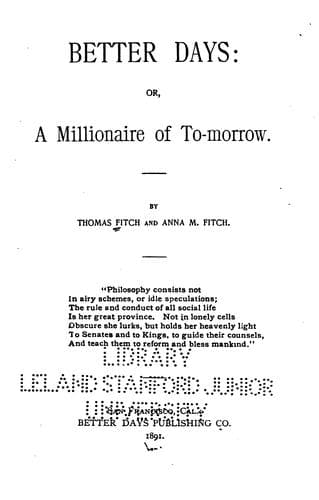
Better days; or, A Millionaire of To-morrowFitch, Thomas
Philosophy
Better days; or, A Millionaire of To-morrow
Fitch, Thomas
Utopias -- Fiction; West (U.S.) -- Fiction
“If he is in Chicago,” replied the Wall Street magnate, “you can have
our dinner served in the room as usual. It will not disturb him,
certainly, even if he should know of it, and he is not likely to know of
it unless you tell him. I have dined in that room with my friends at
least once a week during the last twenty years, and, not supposing you
would ever rent it for other purposes, I have already invited them to
meet me there this evening. I don’t like to change, in fact, I won’t
change, and if you will not accommodate me I will take my patronage
elsewhere.”
After some hesitation, the clerk agreed to have dinner served in the
room desired, and at seven o’clock that evening Mr. Arnold Claybank,
with his guests, Mr. Isaiah Wolf and Mr. John Gray, assembled to discuss
both the menu and the subject of their gathering.
Not until the last course was removed, the Burgundy on the table, the
cigars lighted, and the waiter excused from further attendance, did the
great capitalists approach the real object of their meeting. Mr.
Claybank observed that they might need writing materials, and, stepping
to Morning’s desk, he seated himself thereat, and pulled what he
supposed to be a bell cord that would summon a waiter. No waiter
appeared in answer to the supposed summons, and Claybank, taking a
notebook and pencil from his pocket, remarked that they would serve his
purpose.
These three gentlemen had dined well, and should have been in a pleasant
frame of mind toward the world, for good dinners are, or ought to be,
humanizing in their tendencies. Yet there are natures which will remain
unaffected even by terrapins, Maryland style, and roasted canvas-back
duck, assimilated with the aid of Lafitte and Pommery Sec., and no
tigers crouching in the jungle were ever more merciless and
conscienceless in their rapacity than these three black-coated
capitalists.
Mr. Arnold Claybank was the leading spirit of the conclave. His wealth
was popularly estimated at $100,000,000. He had inherited none of it. At
thirty-five years of age he was a dry goods merchant in an interior city
in Ohio, possessed of less than $100,000. During his frequent visits to
New York to purchase goods he was in the habit of “taking a flyer” in
the stock market. These flyers proved so continuously successful, and
added so largely to his capital, that in a few years he closed out his
dry goods business, removed permanently to the metropolis, bought a seat
in the stock board, and soon became known as one of the boldest and
shrewdest operators in the street.
Public-domain text, read in full here on John Shaqi.
Reviews
Reviews
No reviews yet
Be the first to share your thoughts on this work.
Elsewhere in the archive
Join the Discussion
Join the discussion
Sign in to leave a comment or review.
Sign InorCreate an account