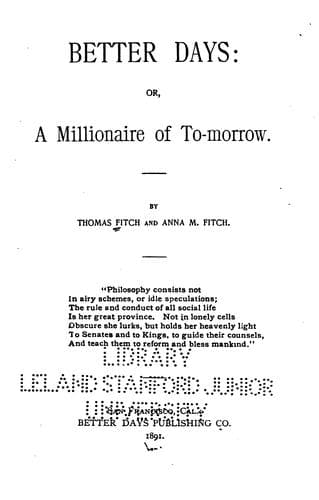
Better days; or, A Millionaire of To-morrowFitch, Thomas
Philosophy
Better days; or, A Millionaire of To-morrow
Fitch, Thomas
Utopias -- Fiction; West (U.S.) -- Fiction
He began life as a Vermont peddler, but at the age of twenty-five
carried his New England education, his capacity for calculation, his
retentive memory, his frugal habits, and his tireless energy into New
York City, where he began as porter and messenger in the office of a
broker. He soon learned the history and methods of the principal
operators of the Wall Street of that day, and his savings were shrewdly,
quietly, and boldly invested on “points” which he picked up while
delivering messages or awaiting replies. He soon accumulated a large sum
of money, yet he kept his humble place, and his employer never suspected
when he paid the faithful porter his $40 at the end of each month, that
the quiet and deferential young man could have purchased not only his
employer’s business, but the building in which it was conducted.
Gray remained as porter and messenger for five years, declining all
offers which were made to him of promotion to a desk and a higher
salary. The place he held gave him opportunities which could be obtained
in no other way. None suspected the quiet and stolid-looking man, who
seemed so dull of comprehension when any verbal message was intrusted to
him; and words were dropped and conversations held in his presence
which, when fitted by his quick and comprehensive brain into other words
and conversations held in other offices, often enabled him to forecast
events. The man who by any means is accurately advised of the real
intentions of the leaders of Wall Street a day or even an hour before
their execution, has a key to wealth, and Gray used this key, conducting
all his operations through one broker, who was pledged to secrecy.
At the time of the great deal in Harlem, so successfully engineered
before the war by Commodore Vanderbilt, Gray was still occupying his
place as messenger. He overheard a conversation held in the commodore’s
private office between that gentleman and his confidential clerk, and,
comprehending the magnitude of the opportunity, he directed that all his
resources, which then amounted to nearly $200,000, be placed in Harlem
stock. He was enabled, under the system of margins which prevailed in
Wall Street, to purchase $2,000,000 worth of the stock, which he sold at
an average advance of fifty per cent, clearing $1,000,000 by the
operation.
The old commodore, who had himself made $6,000,000 by the deal, found
that somebody had been sharing profits with him to the extent of
$1,000,000, and, not supposing that this was the result of guesswork, he
used means to discover who was the cunning operator and what were the
sources of his information. Without much difficulty he traced the
transactions to John Gray, and, remembering the presence of that young
man in the anteroom at the time of giving directions to his confidential
clerk, he was not at a loss to determine how it came about.
Public-domain text, read in full here on John Shaqi.
Reviews
Reviews
No reviews yet
Be the first to share your thoughts on this work.
Elsewhere in the archive
Join the Discussion
Join the discussion
Sign in to leave a comment or review.
Sign InorCreate an account