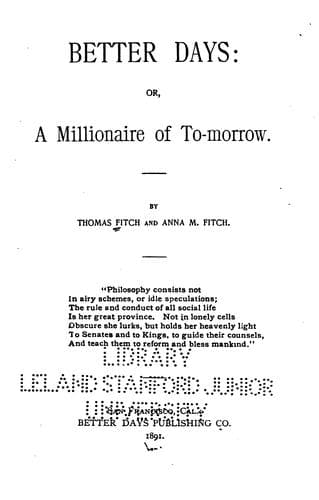
Better days; or, A Millionaire of To-morrowFitch, Thomas
Philosophy
Better days; or, A Millionaire of To-morrow
Fitch, Thomas
Utopias -- Fiction; West (U.S.) -- Fiction
And when the returns were all in at the office of the old commodore, and
that white-whiskered, choleric, kind-hearted, and courageous old bull
found that he owned more Erie than ever, at higher prices than those for
which he had sold a small part of his holdings, and that the rattan
which he had prepared for Gray had fallen upon his own shoulders, he
stormed for a while and clothed himself with cursing as with a garment,
and then he cooled off and laughed. Then he sent a note, this time not
to John Gray’s employer, but to John Gray himself, which read as
follows: “Young fellow, you are a genius. Come and dine with me at six
o’clock to-day, at Delmonico’s. C. V.”
The friendship cemented at that dinner, between the great capitalist and
the ex-messenger—for Gray returned no more to his duties as a
porter—continued until the day of the commodore’s death.
Gray continued to operate in Wall Street, both in small and large ways,
and seldom made a loss. When the first loud mutterings of the civil
conflict began to shake the land, he became a heavy purchaser of tar,
resin, and cotton, and, later, of gold. When the Union armies were
defeated and the day looked darkest, and gold mounted to two hundred and
eighty premium, he never faltered in his belief in the ultimate triumph
of the nation, and he sold gold and bought government bonds, and
margined one against the other, and risked little and gained much.
A year after the sun went down upon Appomattox, the Yankee peddler was
worth $20,000,000, and ten years later he was worth $50,000,000. He
abandoned such stock operations as were dependent for their success upon
other men’s movements and plans, and only engaged in such as he could
absolutely control. He gambled only with marked cards and loaded dice.
He bought a control of the stocks and bonds of badly-managed and
bankrupt railroads. He consolidated them, re-equipped them, built
feeders, opened new sources of traffic, and so doubled, trebled, and
quadrupled his investments. He sold short the stock of a prosperous
railroad, and obtained, by purchase of proxies, the control of its
management. He cut rates, diminished traffic, enlarged expenses, and
passed dividends until he depreciated the value of the stock to a point
where he could gain millions by covering his shorts, and other millions
by again restoring the road to prosperity. In one instance, by his paid
emissaries, he promoted a general strike, until, through riot and fires
and suspension of traffic, the stock of the afflicted corporation was
depreciated to the price at which he desired to purchase a controlling
interest.
Public-domain text, read in full here on John Shaqi.
Reviews
Reviews
No reviews yet
Be the first to share your thoughts on this work.
Elsewhere in the archive
Join the Discussion
Join the discussion
Sign in to leave a comment or review.
Sign InorCreate an account