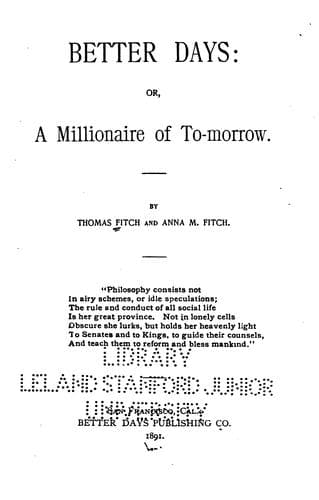
Better days; or, A Millionaire of To-morrowFitch, Thomas
Philosophy
Better days; or, A Millionaire of To-morrow
Fitch, Thomas
Utopias -- Fiction; West (U.S.) -- Fiction
Morning was also a member of the Stock Exchange, having purchased a seat
a year previously, but he did not often appear there, and had never
bought or sold a share of stock himself in open board. Even amid the
excitement of the panic, his presence gave interest to the occasion, for
his sobriquet of the “Gold King” attached legitimately to his ownership
of a mine that was yielding $4,000,000 per month, with the probability
of making its owner in a few years the greatest billionaire in the
world.
There were probably few among the active members of the Stock Exchange
who did not, at this time, know nearly as much about the causes of the
panic as even the three men who produced it, and among all the brokers,
except those in the employment of the syndicate, only indignation was
expressed at the operations of Wolf, Claybank, and Gray. The New York
stockbroker is neither a Shylock nor a miser. He is usually a genial,
generous sort of fellow, who prefers a bull market to a bear raid. He
likes to make money himself and have everybody else make it. A boom is
his delight, and a panic his abhorrence. If a majority of the board of
brokers could have had their way, they would have hung the members of
the syndicate to the gallery railings, and the question of reaching them
in some lawful way, and relieving the board from the effects of their
conspiracy, had been informally discussed.
But nothing was attempted, because nothing seemed really practicable. It
was well known that the existing condition of things had been produced
by locking up the currency. So long as it remained locked up, prices
must remain at whatever figures the conspirators might choose to place
them. Only the power that withdrew the money from circulation, could
restore it to the channels of commerce. There was absolutely nothing for
those not already ruined to do except to hide in the jungle until the
three tigers should have fully gorged themselves. When Claybank, Gray,
and Wolf should graciously permit the money to be unlocked, then stocks
would advance to their real value, business would resume its proper
channels, and the panic would be over—and not until then.
In the Exchange, stocks were called alphabetically, and the first upon
the list of railroad securities was the Atchison, Topeka, and Santa Fe.
This was not a dividend-paying or favorite investment stock, and,
probably, three-fourths of it had been held in the street for years, in
speculative and marginal holdings. Morning had special reasons for
securing control of this road in addition to his general purpose of
thwarting the conspirators. Prior to the panic, Atchison, Topeka, and
Santa Fe had vibrated for months between $27 and $33, and on the
Saturday previous to the Monday which saw the beginning of the bear
raid, it had closed at $30. Under the operations of the conspirators, it
had been hammered down to $15, at which figure it closed on the previous
Saturday.
Public-domain text, read in full here on John Shaqi.
Reviews
Reviews
No reviews yet
Be the first to share your thoughts on this work.
Elsewhere in the archive
Join the Discussion
Join the discussion
Sign in to leave a comment or review.
Sign InorCreate an account