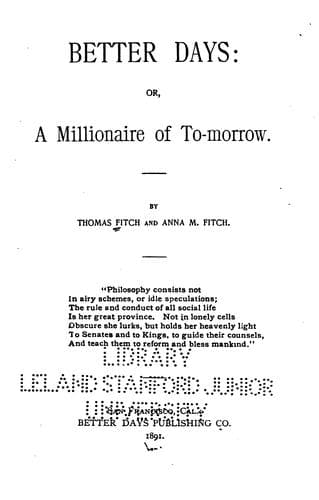
Better days; or, A Millionaire of To-morrowFitch, Thomas
Philosophy
Better days; or, A Millionaire of To-morrow
Fitch, Thomas
Utopias -- Fiction; West (U.S.) -- Fiction
“No, the habit of careless unthrift is common to all men. It is not
confined to the worker. It appears more frequently in him only because
his necessities are more urgent and apparent, and, in this respect, he
lives more in public. But extravagance is a part of the original savage
man, the leaven which has survived all civilization. I have known
lawyers, and doctors, and divines, and journalists who, with their
families, might have been saved from embarrassment and suffering if
there had been some power every month to seize a portion of their
earnings or income and make a compulsory investment of it for their
future benefit.”
“But,” said the speaker, “to return to my subject. There is yet another
advantage to be considered. If the United States operated, or even
supervised, all the railroads, it would not be difficult—by requiring
each railroad hand to report for drill and practice one day in each
month—it would not be difficult to provide the nucleus and material for
a great army, if such should ever again be necessary.”
“Will the time ever come when armies can be dispensed with, Mr.
Morning?”
“I think it has come. I am about to have made some experiments with the
new explosive ‘potentite,’ which, if successful, will, I think,
demonstrate to the world that hereafter war will mean simply mutual
annihilation, and that in conflict there will be small odds between the
weakest and the most powerful of nations. But I wander into the domain
of speculation, and you newspaper men require only facts.”
“Do you propose any reform or changes in the present methods of railroad
management, Mr. Morning?”
“Several.”
“For instance?”
“There will be a uniform rate per mile for passage, all tickets will be
transferable, no inducements will be offered to travelers to perpetrate
falsehood and forgery, and freighters will not be required to expose
their business secrets to the officers of the railroad company.
“Do you know,” said Mr. Morning, “that a demand has actually been made
upon me by the railroad companies for freight at regular express gold
bullion rates on $2,500,000,000 worth of gold bars which they carried
from Arizona to the East disguised as copper? For freight on the
supposed copper I paid their regular rates of charges, amounting to
about $200,000. They say that if I had shipped it as gold their charges
would have been six and one-quarter millions, and they claim the
difference.”
“But you shipped it as copper at your own risk, did you not, Mr.
Morning?”
“Of course I shipped it as copper at my own risk, and on ten bars, worth
really $400,000, which were lost from the ferryboat in transporting
freight during the flood at Yuma, I collected from the company only
their supposed copper value of $320, and I had no end of trouble and
delay in making the collection. But they assert that in covering the
gold bars with copper sheaths, I worked a ‘gold brick swindle’ on them,
and they want the difference.”
Public-domain text, read in full here on John Shaqi.
Reviews
Reviews
No reviews yet
Be the first to share your thoughts on this work.
Elsewhere in the archive
Join the Discussion
Join the discussion
Sign in to leave a comment or review.
Sign InorCreate an account