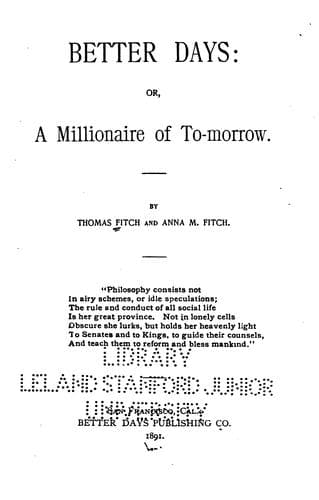
Better days; or, A Millionaire of To-morrowFitch, Thomas
Philosophy
Better days; or, A Millionaire of To-morrow
Fitch, Thomas
Utopias -- Fiction; West (U.S.) -- Fiction
“Well, not at all, suh. The place was owned by my uncle, and he jest
lived there since the wah, and never tried to make a crap. He was
Captain of Company K of the Ninety-third Alabama. He was wounded at
Chickamauga. Both of his sons were killed at the second battle of the
Wilderness; his wife died while they were all away, and when he kem back
he seemed to lose all interest like. He couldn’t abide free niggahs
ever, and there were no othahs, and foh twenty-seven yeahs he jest moped
around the old place, raisin’ only a little cohn, and a few hogs and
some geyahden truck. Last spring he died, and the place has fallen to
me. There is no debt on it, and it’s prime cotton land, but it will take
right smaht of money to clean off the land and put in a crap.”
“Are you farming elsewhere, Mr. Turpin?”
“No, suh, I have been wuking for several yeahs for the Louisville and
Nashville Railroad Company, as their station agent at Coosa, but I was
raised on a cotton plantation, and I know all about the wuk. I have two
likely boys; one is twenty and the othah eighteen. My wife is a wohkah,
and so is our daughtah. We all want to go on the old plantation and live
thar.”
“Will $3,000 clear the land and stock it?”
“Yes, suh. It will buy us mules and fahm implements, and seed, and
supply us with provisions and foddah, and pay the wages of such niggahs
as we will hiah to help us.”
“How soon could you repay the $3,000.”
“Well, in the old times we could moh than pay it with one crap, but thar
ain’t the money in cotton that thar used to be. Cotton is powerful low,
I do allow.”
“And it costs more to raise it now than it did when you had slaves to
work for you, does it not, Mr. Turpin?”
“Well, I allow that don’t make much diffahence, suh. I can hiah niggahs
now for $16 a month, and they find their own keep, while befoh the wah
we had to pay that much and moah, and feed them beside. The interest on
the value of a good niggah then was nigh onto as much as we pay him now
foh wages. The niggah don’t get much moah now than he did when he was in
slavery. He just gets his keep and a few clothes: No, suh, I can raise
cotton now cheaper than I could befoh the wah, but cotton kain’t be sold
foh no such prices. Still, thar is some money in cotton, and my boys and
I can pay off the $3,000 with interest, out of the profits on the craps,
in three yeahs, and if we live powerful close mebbe we can do it in two
yeahs.”
“Why do you not get the money you want from the bank at Huntsville?”
“Well, suh, I went thar before I kem yeah, and the kashyea thar tole me
that they wah not fixed to make any but shote loans. He said as how they
wah a nayshunal bank, and couldn’t loan money on land nohow, and he
advised me to come heah, suh.”
“But this is also a national bank, and subject to the same restriction,
Mr. Turpin.”
“Yes, suh, I know; so he tole me, suh. But he said as how you wah also
loan agents for Northern capitalists, who had money to invest in long
loans, on good security.”
Public-domain text, read in full here on John Shaqi.
Reviews
Reviews
No reviews yet
Be the first to share your thoughts on this work.
Elsewhere in the archive
Join the Discussion
Join the discussion
Sign in to leave a comment or review.
Sign InorCreate an account