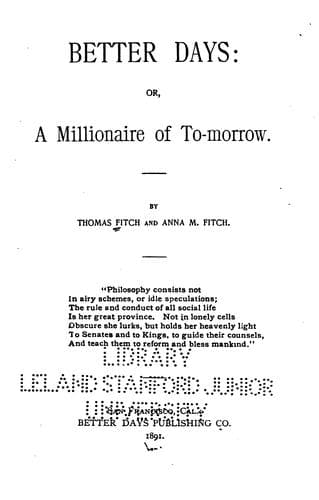
Better days; or, A Millionaire of To-morrowFitch, Thomas
Philosophy
Better days; or, A Millionaire of To-morrow
Fitch, Thomas
Utopias -- Fiction; West (U.S.) -- Fiction
The farmers, of all men, most need the aid of capital, and of all men
they find it most difficult to secure such aid. For years before the
accidental, or, rather, providential, discovery of an immense deposit
of gold-bearing quartz in the Santa Catalina Mountains in Arizona
enabled me to attempt alleviation of some of the evils under which the
world suffers, I had observed that even when the manufacturing and
commercial interests of the land were in a fairly prosperous
condition, the farmers did not share in the general bounty, and I
observed that usually the produce of the farmers’ land could only be
sold at such low prices as left them, at the close of the season, a
little more in debt, and much more discouraged.
The official report of the Illinois State Board of Agriculture for
1889 exhibited the distressing fact that the corn crop of that State
for that year actually sold for $10,000,000 less than it cost to
produce it, and conditions since then have only slightly improved.
Even as I write, there are thousands of families all over the land,
not merely in a few localities where the crops have failed, but on the
virgin prairies of Dakota, on the rich soil of the Mississippi
bottoms, and in the fertile valleys of Virginia, who are in distress,
not because they have been idle or dissolute, but because their last
crops did not sell for enough to pay the cost of their production and
transportation to market, including interest at six, eight, and ten
per cent per annum on the value of the land.
Low prices, according to all standard writers on political economy,
are the direct results of a contracting currency, and a consequent
increasing scarcity of money, and the cost of production is not only
greatly increased by inability of the producer to obtain money except
at high rates of interest, but the terms upon which money can be had
at all are often so exacting as to discourage permanent improvement.
The farmer will not cultivate except for immediate crops if he sees no
hopeful outlook for the future, and not only fears but expects that
the mortgage he has given will, in the end, cause his home to be
transferred to a purchaser at sheriff’s sale.
The yield of the Morning mine has already largely increased the volume
of standard money all over the world, and this may do much toward
removing some of the unfortunate conditions to which I have referred;
but such yield may also have a tendency to discourage the loaning of
money on long loans, for men who have means to invest may prefer to
place them in property, the value of which must advance with the
increase of the volume of money, rather than in loans, the value of
which must remain stationary absolutely, and cannot but diminish
relatively.
Public-domain text, read in full here on John Shaqi.
Reviews
Reviews
No reviews yet
Be the first to share your thoughts on this work.
Elsewhere in the archive
Join the Discussion
Join the discussion
Sign in to leave a comment or review.
Sign InorCreate an account