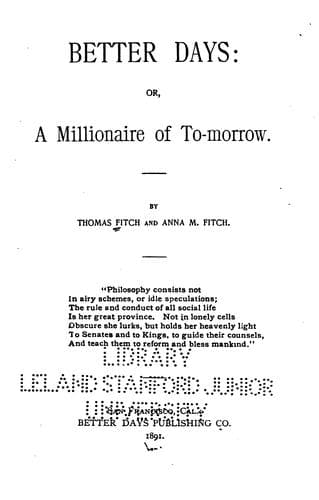
Better days; or, A Millionaire of To-morrowFitch, Thomas
Philosophy
Better days; or, A Millionaire of To-morrow
Fitch, Thomas
Utopias -- Fiction; West (U.S.) -- Fiction
“Oh,” retorted Murella with pretty nonchalance, “I no care! I lofe amuse
myself,” leading the way to the main saloon. “I haf always parteekler
frent, same as baroness, ess it not?” and she sank indolently into the
cushioned depths of a primrose sofa, waving the baroness to a place
beside her, and leaving the party to make choice of seats.
A glance at the original design and superb appointments of this interior
suggested the incongruity of hammocks and _ollas_, yet here they were
many times repeated, for “ice is the devil’s nectar,” runs a Spanish
proverb, and the _olla_ has no rival save the mescal jug.
Every well-to-do Mexican family keeps beneath its roof a corps of female
retainers, who are neither servants nor guests, but something between
the two. They dine—except on occasions—at the family board, and mingle
always at the family gathering, but they assist in the household labors,
and sometimes, though not often, receive a stated money compensation.
They are usually relatives, more or less distant, of the mistress of the
household. The beautiful casa and great wealth of the Gonzales family
had nearly depopulated the neighboring Mexican State of Sonora of all
the needy Alvarados who could claim kinship with the Donna Maria, and a
dozen of these señoritas now appeared shyly at the doors, their
mantillas closely drawn, though the day was warm, and many voices and
excellent music were heard from all quarters of the house and grounds.
After a few moments the Señora Gonzales, with her brother, Don Manuel
Alvarado, who acted as major-domo of the estate, were presented, but the
señora soon glided away unobserved, leaving her brother to the honors of
guide over the mansion.
“You are very beautiful,” spoke Murella with apparent naiveté, as they
arose to follow the party who had preceded them.
The smile of the baroness was tinged with bitterness as she turned to
look into the Madonna face beside her, and ventured to reply.
“And Señor Morning lofes you like heaven and the angels,” she continued
unctuously.
“Señorita, you forget that I have a husband.”
“Is he jealous?”
“Surely no,” replied the baroness sincerely.
“Then I no know what you mean a.”
“I mean that I owe a wife’s duty to the baron,” slowly, with rising
color.
“And what you owe a to the other fellow?” meaning Morning.
The baroness was too much confused to speak.
“You know him a long time?”
“Before I married the baron and went abroad.”
“And you lofe him all these a year? Oh thunner!”
Murella’s English must be taken with many grains of allowance. The
strongest words in a foreign or unfamiliar tongue seem ineffectual and
weak.
“I must plead the indulgence of a guest,” laughed the baroness, “and
withdraw myself from the searching operations of your cunning catechism,
or turn the lights upon you. How long have you known—”
But the señorita had softly glided away, standing apart and giving
hurried orders for luncheon.
Public-domain text, read in full here on John Shaqi.
Reviews
Reviews
No reviews yet
Be the first to share your thoughts on this work.
Elsewhere in the archive
Join the Discussion
Join the discussion
Sign in to leave a comment or review.
Sign InorCreate an account