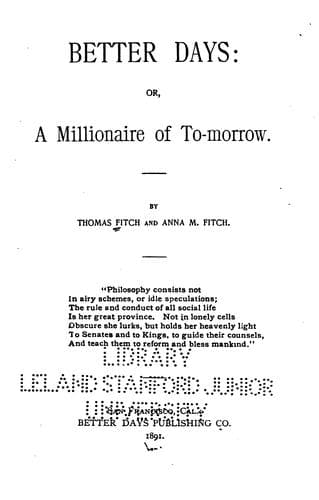
Better days; or, A Millionaire of To-morrowFitch, Thomas
Philosophy
Better days; or, A Millionaire of To-morrow
Fitch, Thomas
Utopias -- Fiction; West (U.S.) -- Fiction
Moved by some impulse, which perhaps she could not have explained to
herself, she took occasion when thanking Morning for saving her
daughter’s life, to confide to him the history of how Ellen’s marriage
had been brought about, to which she added the story of her married
life, and concluded by pressing upon him for perusal, a package of her
daughter’s letters. These Morning carried with him to Chicago, and their
reading induced him, after parting with his distinguished guests, to
hasten his return to Coronado, where he was advised that the Von Eulaw
party would remain for some weeks.
On a delicious afternoon the baroness, with Mrs. Thornton and Miss
Winters, sat in the gallery overhanging the old music hall on the sea.
Although a new and costlier edifice had been built, with improved
acoustics and elaborate design, the little gem at the corner of the
hotel, long washed by the waves and threatened by the breakers, seemed
still a favorite resort for concert and afternoon recitals, and thither
came many who sought for a restful hour under the eloquent discourse of
the old white-haired professor’s violin.
“It is a pity for the world,” said Miss Winters, during a pause in the
performance, “that so few are able to look into the soul of Tolstoi’s
labors. In one of his chapters he expresses the epitome of all musical
sensations in half a dozen lines.”
“I hope you are not referring to the ‘Kreutzer Sonata,’ Miss Winters,”
broke in Mrs. Thornton.
Miss Winters smiled rather than spoke reply. But the baroness took
greater liberty and rejoined rather saucily, “The regular thing, dear
mother, is to ask for some palliative to remove the taste from your
mouth after the mention of the much-abused ‘Kreutzer Sonata.’”
Mrs. Thornton replied with a look of high disdain and much fluttering of
ribbons.
“I am not punctilious, but I could not sit and listen to a defense of
that man.”
“I am not defending him, though I might, especially if he were my
client,” laughed Miss Winters. “I am only deploring that the world will
not forgive his truths nor forget his faults in the universal power of
his genius.”
It was well that the next on the programme was Beethoven’s seventh
symphony, and that the men strolled in soon afterwards, for nothing is
so prolific of enmities as the subject of Tolstoi, unless it be that of
tariff.
The enchanting numbers were ended, and the ladies left the hall, the men
taking another direction. At the foot of the stairway they were accosted
by David Morning, who, after a greeting, turned and joined the baroness.
“When did you return?” said she, looking full into his bronzed face, and
again at his traveling clothes.
“Only this moment. And how are you? and has the baron entirely
recovered?”
“Completely, I believe, and for me, one could not be so ungrateful as to
be ill in this place.”
“I trust not,” replied Morning absently.
Public-domain text, read in full here on John Shaqi.
Reviews
Reviews
No reviews yet
Be the first to share your thoughts on this work.
Elsewhere in the archive
Join the Discussion
Join the discussion
Sign in to leave a comment or review.
Sign InorCreate an account