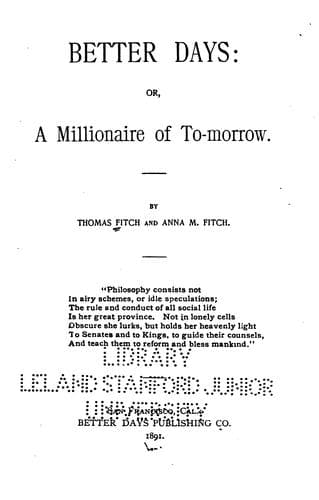
Better days; or, A Millionaire of To-morrowFitch, Thomas
Philosophy
Better days; or, A Millionaire of To-morrow
Fitch, Thomas
Utopias -- Fiction; West (U.S.) -- Fiction
Somewhat, too, our institutions of marriage are at fault, or at least
the laws and customs which control them. With a nation of men, free,
rational, and liberal, we have a nation of women enslaved, dishonest,
and miserable, and it is among her noblest and most common phases of
fate that she goes mutely to her grave, a victim of such weak social
prejudices as have grown to be even a subject of satire among Europeans.
Conscientiousness is a boasted virtue among Boston people of certain
high cult, yet how many of her beautiful women go to the altar with a
lie upon their maidenly lips? Why?—For the reason that there is some man
whom she loves and dares not declare it. For the reason that society
sets a seal upon her lips and turns her life into a drain-channel for
misbegotten vows. For the reason that she cannot break the frost-bound
usages of cowardly error with one stroke of her puny fist, and openly
propose to join fortunes with the man after her own heart and her own
high convictions. And so she rakes over the cold, unfruitful soil in her
own soul, and plants the germ of a falsehood or a folly, and waits for
the accident of some quickening power, in slavish and unheroic patience.
Witness the result: Some masculine hand, more or less clumsy or more or
less cunning, little matter if it bring a wedding ring, sheds ephemeral
warmth upon the unsanctified ground, and the victim starts upon her
lonely, loveless journey toward race building and sacrifice.
As I indicated, dear Fanny, I have not drawn for my picture largely upon
individual experiences, neither are my opinions stimulated by any
observations taken from this side the water. Indeed, I even prefer, of
kindred evils, the insipid method which leaves the marriage question in
the hands of the parents. But let me leave this for subsequent
discussion, for my letter is already too long, and I have not gossiped
at all, and I remember, dear girl, how you do love innocent gossip.
Write to me often and I will fill my letters with the sweetest of
nothings if you will. Love and adieu and think of me as your devoted
friend,
ELLEN.
_From the Baroness Von Eulaw to Mrs. Perces Thornton._
BERLIN, May 10, 1893.
DEAREST MOTHER: “Let fate do her worst, there are moments of joy,” and
such moments I owe to my fondness for music. What would have been all
these dreary weeks and months of shallow acting, if the depths of my
soul had not been stirred by the genius of that creative force which,
mocking at our own crude disguises, rehabilitates pain with the fair
seeming of pleasure, which relegates near sorrows to the realms of
tradition, and illusionises common care?
Public-domain text, read in full here on John Shaqi.
Reviews
Reviews
No reviews yet
Be the first to share your thoughts on this work.
Elsewhere in the archive
Join the Discussion
Join the discussion
Sign in to leave a comment or review.
Sign InorCreate an account