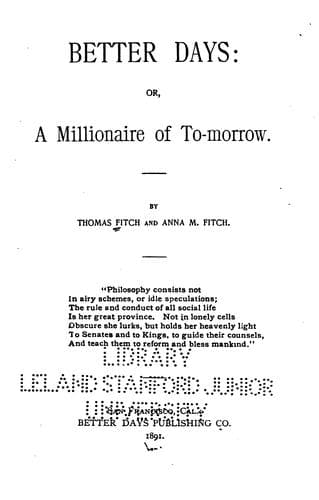
Better days; or, A Millionaire of To-morrowFitch, Thomas
Philosophy
Better days; or, A Millionaire of To-morrow
Fitch, Thomas
Utopias -- Fiction; West (U.S.) -- Fiction
Art, in any form, I conceive to be the benefactor of the human race. If
truth, shorn of its infinitude of possibilities, constitutes the
religion of the civilized world, if the _deus et machina_, as Æschylus
somewhere has it, unlyrical and unleavened by beauty of device, by
rhetoric or action and climax, be persuasive and instructive and
inspiring, then how ineffably shall truth have gained by the development
of its powers through visible forms of dramatic conceit, through
association with the elements of art, through characterization, through
skillful adaptation, through harmonized mediæ of appeal to the sense or
the sentiment, the sympathies or the imagination?
I am reminded here of an incident which occurred in our box at the Grand
Opera House, during a late performance of Die Meistersinger, which
resulted—as is not unusual in these days—unpleasantly. My husband, as
you may remember, affects music solely for the paraphernalia of the
stage, for the glitter and show of boxes and stalls, for the exposed
shoulders of the diamonded dames of fashion, for the numbers of men with
eyeglasses and uniforms—anything, in fact, but the music, which rather
bores him.
Therefore it is I apprehend that he discusses music so
incomprehensibly—to say the least—I would not say irrationally.
Somewhere during the development of the plot I was struck with the
similarity of the dramatic motive with that of the Greek tragedies,
especially the choral odes, where occurs the element of transition which
some scholars call the evolutionary or perhaps the re-incarnating period
of the ancient drama. This similarity—in some ways identical—I
inadvertently alluded to in a more or less critical review of the opera
and its construction, which I ventured between acts, in the presence of
a party of Americans who were our guests for the occasion.
Suddenly as thought, the baron’s face was aflame. But “what it were
unwise to do ’twere weaker to regret,” and I prepared to defend my
position as best became me. “You call my divine countryman a
plagiarist,” he hissed between his teeth. Our male guest glowered, and
the ladies with heightened color looked at the orchestra.
“I beg your pardon, sir,” said I, with an assumed smile, “I did not say
so, though I admit that my suggestion was unfortunate in its inference.”
The baron sprang to his feet and stood over me, his arms akimbo and the
well-known look of suppressed rage upon his face.
“You called my divine countryman a plagiarist,” he repeated, gazing out
over the audience, and feeling for my slippered foot with his heel,
which he settled firmly upon my silken-clad instep. The hurt made me
wince, but I could not remove my foot from the vise. Then, in order to
mollify his temper, which I had grown to know too well how to deal with,
I added laughingly, though half wild with pain as he deadened his weight
upon my poor instep:—
Public-domain text, read in full here on John Shaqi.
Reviews
Reviews
No reviews yet
Be the first to share your thoughts on this work.
Elsewhere in the archive
Join the Discussion
Join the discussion
Sign in to leave a comment or review.
Sign InorCreate an account