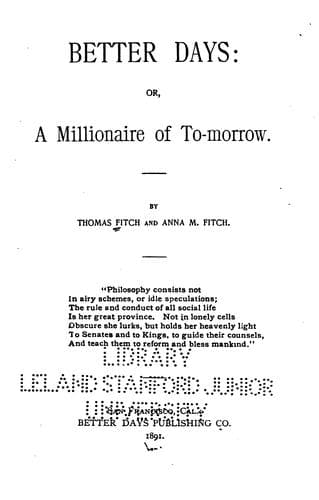
Better days; or, A Millionaire of To-morrowFitch, Thomas
Philosophy
Better days; or, A Millionaire of To-morrow
Fitch, Thomas
Utopias -- Fiction; West (U.S.) -- Fiction
This morning I looked from my windows upon the river. The sharp lights I
had watched so often swiftly changing to shadows, the warring glances
suggestive only of inner strife, with all its complexity of passion,
were lost in the soft peaceful flow of the waters as they hurried on to
the ultimate sea. And I thought how much of this mood is due to fancy,
that untenable, mercurial, and sublimated quality of the mind, half
trickery, half truth, and altogether elusive as vapor. But how
profligate of that precious sense of pleasure so steadily withheld from
my heart these later months! Too precious, indeed, for the operations
and experiments of the mental laboratory to which I seemingly so
recklessly submitted it, and so I dismissed analysis and clung to my
fancies, which at least made me happy in the present.
After my breakfast I prepared myself for a walk, with only my little
fox-terrier for a companion. Poor little Boston, how grateful he seemed!
I could see him laugh with joy as his little brown lips quivered with
flexible feeling. Notwithstanding his many years, he could scarcely find
footing for his bounding steps for looking back at me to search my
laughing eyes. You remember who gave me my terrier, away out in Denver?
how he was brought to me in two strong, guardful arms, a little
loose-skinned, wise-eyed puppy, so quiet and serenely happy in the warm
embrace—where was I? oh, yes! talking about Boston—so we pulled some
roses, Boston and I. But never looked roses so red, or green so tender
or so vivid, and I longed to find the secret of their voluptuous bloom
and half-suffocating fragrance, but that I guessed all was again fancy;
only an easy, translatable pinch of dust and a resolvable stain; a
simple stroke of creative power and a dash of ether—only a rose.
How easy seem the processes of nature with harmonized material for
working out the thought! Nature never experiments; gravitation is her
law, deflection is anarchy, and defiance a destroyer. Love, I deem, is
only obedience to this law. Obscure as are its operations and subtle as
its teachings are, any smallest portion of scholarship, leveled at the
finding out, divested of preconceived ideas and personal bearings, but
persistently and conscientiously agitated by scientific and organized
effort, might revolutionize a world of error, and establish a sure basis
for sentiment and social reform.
For I believe that unhappy marriages are a direct result of ignorance.
Passions called by various names go to make up the system. Sordidness,
vanity, interdependence, weak abeyance to custom, contribute to the sum
of human misery. But ignorance is the basis of the organized error. For
what manner of men or women would deliberately entail upon themselves
the shackled conditions of a loveless marriage, which has no alternative
but subordination or rebellion? For only in love—another name for
harmony—may be found that unity which leaves no room for sacrifice or
misconceit.
Public-domain text, read in full here on John Shaqi.
Reviews
Reviews
No reviews yet
Be the first to share your thoughts on this work.
Elsewhere in the archive
Join the Discussion
Join the discussion
Sign in to leave a comment or review.
Sign InorCreate an account