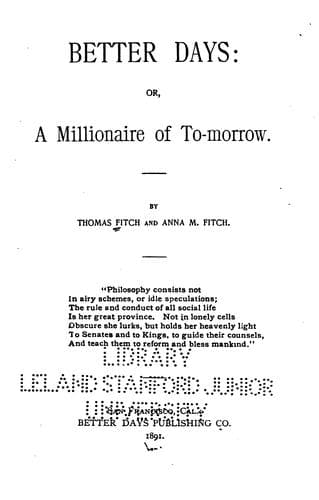
Better days; or, A Millionaire of To-morrowFitch, Thomas
Philosophy
Better days; or, A Millionaire of To-morrow
Fitch, Thomas
Utopias -- Fiction; West (U.S.) -- Fiction
But the baron came home, as I said, quite confirmed in many unpleasant
ways I had remarked before. Without any apparent cause he stole about my
room in unslippered feet, and listened furtively at the keyholes. He
locked the doors whenever he passed through, and spoke to the servants
through a crevice. Instead of his usual violence he whined his
complaints of my demeanor toward him in the weakest and most supine
fashion. But that which exasperated me most was, and is still, his
unaccountable pertinacity. He would place his chair close by me and hold
his knee against mine, or his elbow, or his foot, while, with purpling
face and hanging mouth, he entreated me not to leave him, until, in half
insane protest, I would break clear of him and throw open a window, or
bathe my hands and face in utter exhaustion, or—I had almost said—sense
of contamination. In his fits of rage there is something genuine from an
animal, if not from a manly, point of view. But how shall I deal with
this new phase? Ah, well! let me get on with my letter, for I have much
to say, and that is why I am dallying.
I consented to come to Mentone on account of my health. Finding myself
growing weak and failing, the physicians ordered an immediate change,
and recommended the old cure virtually—to take myself out of their
hands. The baron loves to play, and I suspect is a little too well known
in gaming circles in Berlin.
Therefore when he proposed Mentone so early in the season, or, indeed,
altogether out of season, I—quite knowing that it meant Monte
Carlo—accepted, and with valet and maid and dear old Boston we came.
Result, financial ruin! The baron played recklessly. Each time when I
saw him he was feverish and abstracted. I did not ask the cause, whether
he were winner or loser, for, like most women, I believe that everybody
finally loses, but I was not prepared for the dénouement, for he has
absolutely lost not only all his ready money, but is heavily in debt,
and will need to resort to further mortgage of his landed estates.
Weak and foolhardy as he was, I pity him, for what must have been his
feelings as, driving down the Corniche road overhanging the old sea, he
reflected how many men had sought forgetfulness for just such acts of
folly in the tideless waters. Only that the baron has other ideas about
reparation, for he came home and first proposed that I write my father
for money to make good his losses. Taking courage from my silence, he
suggested that I cable my message at once.
Public-domain text, read in full here on John Shaqi.
Reviews
Reviews
No reviews yet
Be the first to share your thoughts on this work.
Elsewhere in the archive
Join the Discussion
Join the discussion
Sign in to leave a comment or review.
Sign InorCreate an account