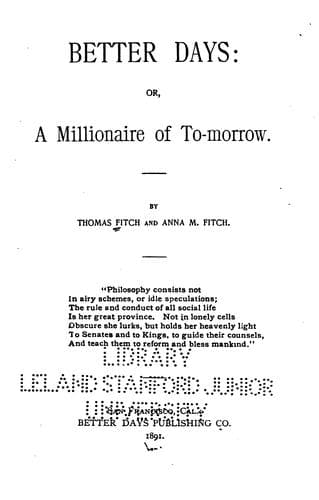
Better days; or, A Millionaire of To-morrowFitch, Thomas
Philosophy
Better days; or, A Millionaire of To-morrow
Fitch, Thomas
Utopias -- Fiction; West (U.S.) -- Fiction
Shall I give you briefly the harrowing details of this ruffianly act of
cowardice? I think I told you in my last how the baron had left the
house, filled with vindictive rage at my refusal to demand of my father
large sums of money for his gambling losses. In about an hour he
returned and renewed his proposition with increased violence, at the
same time seizing a pen and writing a cablegram, which he commanded me
to sign.
Remembering that I had given him considerable sums of money from time to
time, amounting to many thousands of dollars, I entreated him to wait
for a day, while he should make me understand the condition of his
financial affairs. This proposition he received with the most frightful
oaths. He declared that he would take my life, and would begin by
killing my pet dog. No sooner said than done. He rushed to the veranda,
where poor little Boston lay stretched upon his cushion asleep in the
sun, and, seizing him by the neck, he dashed him violently to the ground
below. A few minutes later my little friend was brought to me still
feebly conscious, but mangled, bleeding, dying.
How can I ever forget, who ever did who has ever witnessed it forget
that last questioning, beseeching look of affection and dumb fright
which a dying animal turns upon the face of someone he has loved? Is it
less than human or more? Not till the mists gathered across his pretty
brown eyes was that last eloquent appeal swept away. “What have I done?”
“What have I done?” was the question he was asking of me. Who shall say
whether he received his answer in some later and easier translatable
speech than mine, in some new and disenthralled state of being? Who
shall say that he did not carry away with him a love which was all love,
with no taint of selfishness or ulterior thought, quickened by no new
speculation, or tradition, or sanction, or human edict? Who shall say
that the attributes of faith, and self-surrender, and charity, and
forgiveness, and loyalty are lost because in one incarnation they were
tongue-tied? For myself I want to see my dogs again. They were my loved
companions, as are my books or my works of art. And if the fire destroy
them, are their contents naught or worthless because an unlettered man
could not read them? At best an after life is a problem, but let us put
the problems together and one may help to solve the other, for half a
truth is oftenest a lie.
I have sought distraction in these comments, but my sorrow returns to
me, dear mother, and my eyes are too full of tears to be able to see the
lines. _Vale_, poor Boston, and a grateful throb of gladness that I have
a dear mother to whom I can tell my grief.
Your loving but unhappy ELLEN.
CHAPTER X.
“Lo! the poor Indian.”
Public-domain text, read in full here on John Shaqi.
Reviews
Reviews
No reviews yet
Be the first to share your thoughts on this work.
Elsewhere in the archive
Join the Discussion
Join the discussion
Sign in to leave a comment or review.
Sign InorCreate an account