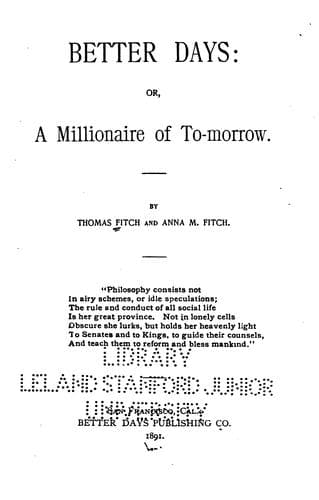
Better days; or, A Millionaire of To-morrowFitch, Thomas
Philosophy
Better days; or, A Millionaire of To-morrow
Fitch, Thomas
Utopias -- Fiction; West (U.S.) -- Fiction
It was argued that if the gold supply of the world was to be increased
forty per cent per annum by the yield of the Morning mine, that would
diminish relatively the production of silver, and the ancient parity of
the metals might be restored “without danger to our financial interests,
Mr. Speaker.”
Thus reasoned the Honorable Senile Jumbo, who represented a New England
district in the House. Jumbo was a banker at home, and because he was a
banker was supposed to know something about finance, and was, in
consequence, accorded a leading position on the House Committee on
Banking and Currency.
In fact, Jumbo only knew a good discount from a poor one. His definition
of a banker would have been that of the Indiana editor, who described
such a functionary as “a gentleman who takes the money of one man
without interest, and loans it to another upon interest, and places both
depositor and borrower under obligations.”
By his small shrewdness Jumbo had gained a large fortune, and secured a
seat in Congress; but of the laws which govern finance in its
politico-economic relations he had no more knowledge than has a
locomotive fireman about the law of dynamics, or a drygoods clerk about
the culture of the silkworm. Yet the Honorable Senile Jumbo looked wise,
and talked from the pit of his stomach, and respected the views of other
rich men, and as a congressman he averaged with his colleagues.
What strange distortion of brain is it that causes men conspicuously
unfit for public life, to seek elevations which can only expose their
intellectual poverty? One who does not comprehend the French tongue or
know anything about science, would be laughed at for seeking to be
elected a member of the French Academy of Sciences, yet senatorial togas
and congressional seats are constantly sought by gentlemen whose
previous pursuits have unfitted them to “shine in the halls of high
debate,” and who, indeed, would be puzzled to put together, while on
their feet, ten sentences of grammatical English.
The great and growing wealth of Morning caused his society to be
courted, and many a managing mamma was not unmindful of the fact that
the “Arizona Gold King,” as he began to be called, was a bachelor. This
man did not “wear his heart upon his sleeve,” and did not proclaim that
his bachelorhood was confirmed, or had any special reason for its
existence, but all plotting against him was in vain, for the Ellen lost
to him was the constant companion of his thoughts, and to all movements
and plans and purposes of life he applied instinctively the test, “What
would she think of it?”
CHAPTER XIII.
“Hopeless grief is passionless.”
It was the anniversary of one of the great victories achieved by Germany
in the war of 1870, and Berlin had scarcely known a day so filled with
noise, and glitter, and color, and esprit as this day had been.
Public-domain text, read in full here on John Shaqi.
Reviews
Reviews
No reviews yet
Be the first to share your thoughts on this work.
Elsewhere in the archive
Join the Discussion
Join the discussion
Sign in to leave a comment or review.
Sign InorCreate an account