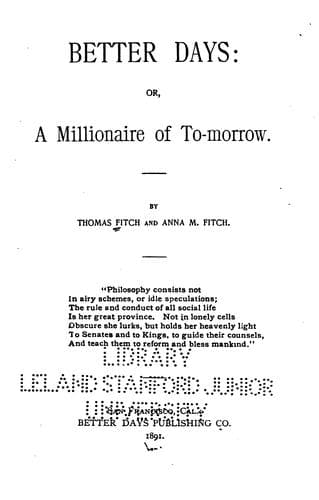
Better days; or, A Millionaire of To-morrowFitch, Thomas
Philosophy
Better days; or, A Millionaire of To-morrow
Fitch, Thomas
Utopias -- Fiction; West (U.S.) -- Fiction
On the next Monday morning there appeared on the scene ten men clad in
blouses and overalls. Three of them worked at mixing mortar, three of
them carried hods, three of them commenced laying brick, while the tenth
man directed the labors of the other nine. Each had buckled about his
waist in plain sight a cartridge belt from which hung a dragoon
revolver.
As soon as their presence and labors became known, word was sent to
labor headquarters, and Delegate Brown was deputed to interview the
strangers and ascertain the situation.
Pap Brown was a journeyman stone cutter on the other side of the
sixties, who did not often work at his trade. The salary he received
from the trade unions was sufficient for his support, and he fully
earned his salary. He was shrewd, suave, and persistent, and his
fatherly way with “the boys,” and deferential manner to employers, often
secured to the former favorable adjustments of contests that would have
been denied to the “silver-tongued” Raffertys and Blathers.
Pap Brown approached one of the men who was engaged in mixing mortar,
and inquired whom he was working for. The man addressed made no reply,
but signaled the foreman, who came forward and curtly answered:—
“We are all working for Mr. Lorin French.”
“What wages do you get?” asked Brown.
“Well,” replied the foreman after a pause, “strictly speaking, I don’t
know as that concerns you, but I have no objection to telling you. The
mortar-mixers and hod-carriers get $3.00 a day, the bricklayers $4.00,
and I get $5.00.”
“Them’s union wages,” said Brown, approvingly. “You are strangers in
Frisco, I jedge?”
“We arrived last Friday night from Milwaukee,” replied the foreman.
“Have you got your cards as members of the union?” said Brown.
“No,” replied the party addressed, “we belong to no union.”
“Hum! I suppose you are calkilatin’ to jine the unions here?” inquired
Brown in a persuasive accent.
“I am told,” replied the foreman, “that so far as the Hod-Carriers’
Union is concerned, we cannot join if we wish to; that they have
resolved to admit no new members.”
Pap Brown slowly revolved his tobacco quid in his mouth, and rapidly
revolved the situation in his wise old brain. “Hum!” said he at length,
“I reckon that can be arranged for ye, so that ye can all jine.”
“Well,” replied the man from Milwaukee, “I may as well tell ye that we
don’t calculate to jine anyhow. We don’t much believe in unions
nohow—too many fellers a settin’ around drinkin’ beer, which the fellers
that work have to pay for.”
“Mebbe you don’t know,” said Pap Brown, “that only union men will be
allowed to work here.”
“Who will stop us?” said the stranger.
“There are a good many thousand of the brotherhood in this city,” said
Delegate Brown, still persuasively, “and there are only ten of you.”
“Well, we ten are fixed to stay,” said the foreman, glancing
significantly at his cartridge belt.
“Hum!” remarked Pap Brown, as he walked away.
Public-domain text, read in full here on John Shaqi.
Reviews
Reviews
No reviews yet
Be the first to share your thoughts on this work.
Elsewhere in the archive
Join the Discussion
Join the discussion
Sign in to leave a comment or review.
Sign InorCreate an account