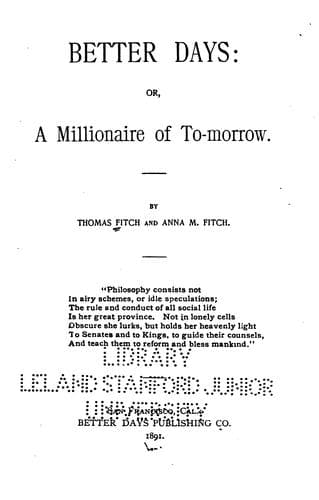
Better days; or, A Millionaire of To-morrowFitch, Thomas
Philosophy
Better days; or, A Millionaire of To-morrow
Fitch, Thomas
Utopias -- Fiction; West (U.S.) -- Fiction
At the close of the third week of the strike the Congress of Federated
Trades assembled and declared a boycott against all members of the
Builders’ and Manufacturers’ Union, and against all who should violate
the boycott; the boycott to run also against any railway or steamship
line that should accord them or their families transportation out of San
Francisco.
It was expected that this last and most drastic measure would bring the
capitalists to terms, for its enforcement would deprive them and their
families of the necessities of life. Their employes left them under the
pressure, and their offices and places of business were closed. Their
house servants departed, and they were unable to obtain substitutes even
among the Chinese, for the Celestial who should labor for a boycotted
household was given his choice between exile and death. Hotel
proprietors were compelled to refuse a boycotted person as a guest, or
lose their own waiters, cooks, and chambermaids. The restaurant
proprietor who should serve one of them with a meal would be compelled
to close his doors for the want of help; and the grocer, fruiterer,
butcher, baker, or provision dealer who sold supplies for their use,
would be posted, and lose his other customers, for the boycott was
declared against all who violated the boycott.
Mr. French was equal to the exigency. He caused representations to be
made, and influence exerted at Washington, and the United States steamer
_Charleston_ was detailed for special service. The members of the
Builders’ and Manufacturers’ Association, with their families, were
taken on board of the war-ship, guarded by the Pinkerton men, and
carried to Vancouver, where they were dispatched East over the Canadian
Pacific Railroad. Lorin French, with a few of his fellow-members,
refused to go, but, establishing themselves comfortably on the upper
floor of the building No. 1099 Market Street, they managed to provision
themselves and their guards, despite the boycott, and announced their
determination to see the contest out.
It was the last week in April, 1894, and the tenth week of the great
strike. Business was almost suspended in San Francisco. Thousands of the
strikers had wandered out into the country, and every farmhouse within a
hundred miles of San Francisco was besieged by men glad to work for food
and shelter, while the highways were crowded with tramps. In the city
the streets were filled with idle thousands, and at the daily meeting at
the sand lots twenty or thirty thousand auditors were addressed by
favorite speakers.
Public-domain text, read in full here on John Shaqi.
Reviews
Reviews
No reviews yet
Be the first to share your thoughts on this work.
Elsewhere in the archive
Join the Discussion
Join the discussion
Sign in to leave a comment or review.
Sign InorCreate an account