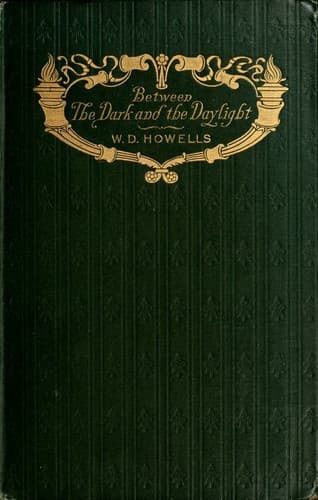
Between the Dark and the DaylightHowells, William Dean
General
Between the Dark and the Daylight
Howells, William Dean
Short stories
The old fellow who told that story of dream-transference on a
sleeping-car at Christmas-time was again at the club on Easter Eve.
Halson had put him up for the winter, under the easy rule we had, and he
had taken very naturally to the Turkish room for his after-dinner coffee
and cigar. We all rather liked him, though it was Minver's pose to be
critical of the simple friendliness with which he made himself at home
among us, and to feign a wish that there were fewer trains between
Boston and New York, so that old Newton (that was his name) could have a
better chance of staying away. But we noticed that Minver was always a
willing listener to Newton's talk, and that he sometimes hospitably
offered to share his tobacco with the Bostonian. When brought to book
for his inconsistency by Rulledge, he said he was merely welcoming the
new blood, if not young blood, that Newton was infusing into our body,
which had grown anaemic on Wanhope's psychology and Rulledge's romance;
or, anyway, it was a change.
Newton now began by saying abruptly, in a fashion he had, "We used to
hear a good deal in Boston about your Easter Parade here in New York. Do
you still keep it up?"
No one else answering, Minver replied, presently, "I believe it is still
going on. I understand that it's composed mostly of milliners out to
see one another's new hats, and generous Jewesses who are willing to
contribute the 'dark and bright' of the beauty in which they walk to the
observance of an alien faith. It's rather astonishing how the synagogue
takes to the feasts of the church. If it were not for that, I don't know
what would become of Christmas."
"What do you mean by their walking in beauty?" Rulledge asked over his
shoulder.
"I shall never have the measure of your ignorance, Rulledge. You don't
even know Byron's lines on Hebrew loveliness?
"'She walks in beauty like the night
Of cloudless climes and starry skies,
And all that's best of dark and bright
Meets in her aspect and her eyes.'"
"Pretty good," Rulledge assented. "And they _are_ splendid, sometimes.
But what has the Easter Parade got to do with it?" he asked Newton.
"Oh, only what everything has with everything else. I was thinking of
Easter-time long ago and far away, and naturally I thought of Easter now
and here. I saw your Parade once, and it seemed to me one of the great
social spectacles. But you can't keep anything in New York, if it's
good; if it's bad, you can."
"You come from Boston, I think you said, Mr. Newton," Minver breathed
blandly through his smoke.
Public-domain text, read in full here on John Shaqi.
Reviews
Reviews
No reviews yet
Be the first to share your thoughts on this work.
Elsewhere in the archive
Join the Discussion
Join the discussion
Sign in to leave a comment or review.
Sign InorCreate an account