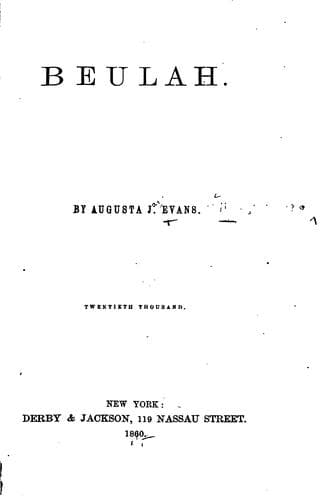
Love stories; Orphans -- Fiction; Southern States -- Fiction; Women -- Fiction
earnest thinkers had essayed the same mighty task, and died under
the intolerable burden? Unluckily for her, there was no one to
direct or assist her. She scrupulously endeavored to conceal her
doubts and questions from her guardian. Poor child? she fancied she
concealed them so effectually from his knowledge; while he silently
noted the march of skepticism in her nature. There were dim,
puzzling passages of Scripture which she studied on her knees; now
trying to comprehend them, and now beseeching the Source of all
knowledge to enlighten her. But, as has happened to numberless
others, there was seemingly no assistance given. The clouds grew
denser and darker, and, like the "cry of strong swimmers in their
agony," her prayers had gone up to the Throne of Grace. Sometimes
she was tempted to go to the minister of the church where she sat
Sunday after Sunday, and beg him to explain the mysteries to her.
But the pompous austerity of his manners repelled her whenever she
thought of broaching the subject, and gradually she saw that she
must work out her own problems. Thus, from week to week and month to
month, she toiled on, with a slowly dying faith, constantly
clambering over obstacles which seemed to stand between her trust
and revelation. It was no longer study for the sake of erudition;
these riddles involved all that she prized in Time and Eternity, and
she grasped books of every description with the eagerness of a
famishing nature. What dire chance threw into her hands such works
as Emerson's, Carlyle's, and Goethe's? Like the waves of the clear,
sunny sea, they only increased her thirst to madness. Her burning
lips were ever at these fountains; and, in her reckless eagerness,
she plunged into the gulf of German speculation. Here she believed
that she had indeed found the "true processes," and, with renewed
zest, continued the work of questioning. At this stage of the
conflict the pestilential scourge was laid upon the city, and she
paused from her metaphysical toil to close glazed eyes and shroud
soulless clay. In the awful hush of those hours of watching she
looked calmly for some solution, and longed for the unquestioning
faith of early years. But these influences passed without aiding her
in the least, and, with rekindled ardor, she went back to her false
prophets. In addition, ethnology beckoned her on to conclusions
apparently antagonistic to the revealed system, and the stony face
of geology seemed radiant with characters of light, which she might
decipher and find some security in. From Dr. Asbury's extensive
collection she snatched treatise after treatise. The sages of
geology talked of the pre-Adamic eras, and of man's ending the
slowly forged chain, of which the radiata form the lowest link; and
then she was told that in those pre-Adamic ages paleontologists find
no trace whatever of that golden time when the vast animal creation
lived in harmony and bloodshed was unknown; ergo, man's fall in Eden
Public-domain text, read in full here on John Shaqi.
Reviews
Reviews
No reviews yet
Be the first to share your thoughts on this work.
Elsewhere in the archive
Join the Discussion
Join the discussion
Sign in to leave a comment or review.
Sign InorCreate an account