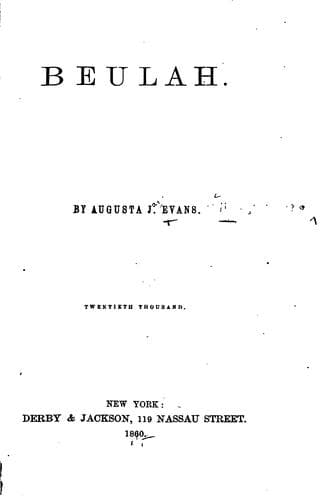
Love stories; Orphans -- Fiction; Southern States -- Fiction; Women -- Fiction
"Of course it nullifies the belief in future adjustments, for he
says emphatically, 'Justice is not postponed. A perfect equity
adjusts its balance in all parts of life.' 'What will you have? Pay
for it, and take it. Nothing venture, nothing have.' There is no
obscurity whatever in that remarkable essay on compensation." Beulah
took up one of the volumes, and turned the pages carelessly.
"But all this would shock a Christian."
"And deservedly; for Emerson's works, collectively and individually,
are aimed at the doctrines of Christianity. There is a grim,
terrible fatalism scowling on his pages which might well frighten
the reader who clasped the Bible to his heart."
"Yet you accept his 'compensation.' Are you prepared to receive his
deistic system?" Cornelia leaned forward and spoke eagerly. Beulah
smiled.
"Why strive to cloak the truth? I should not term his fragmentary
system 'deistic.' He knows not yet what he believes. There are
singular antagonisms existing among even his pet theories."
"I have not found any," replied Cornelia, with a gesture of
impatience.
"Then you have not studied his works as closely as I have done. In
one place he tells you he feels 'the eternity of man, the identity
of his thought,' that Plato's truth and Pindar's fire belong as much
to him as to the ancient Greeks, and on the opposite page, if I
remember aright, he says, 'Rare extravagant spirits come by us at
intervals, who disclose to us new facts in nature. I see that men of
God have, from time to time, walked among men, and made their
commission felt in the heart and soul of the commonest hearer.
Hence, evidently the tripod, the priest, the priestess, inspired by
the divine afflatus.' Thus at one moment he finds no 'antiquity in
the worships of Moses, of Zoroaster, of Menu, or Socrates; they are
as much his as theirs,' and at another clearly asserts that spirits
do come into the world to discover to us new truths. At some points
we are told that the cycles of time reproduce all things; at others,
this theory is denied. Again, in 'Self-Reliance,' he says,' Trust
thyself; insist on yourself; obey thy heart, and thou shalt
reproduce the foreworld again.' All this was very comforting to me,
Cornelia; self-reliance was the great secret of success and
happiness; but I chanced to read the 'Over-soul' soon after, and lo!
these words: 'I am constrained every moment to acknowledge a higher
origin for events than the will I call mine.' This was directly
antagonistic to the entire spirit of 'self-reliance'; but I read on,
and soon found the last sentence utterly nullified by one which
declared positively 'that the Highest dwells with man; the sources
of nature are in his own mind.' Sometimes we are informed that our
souls are self-existing and all-powerful; an incarnation of the
divine and universal, and, before we fairly digest this tremendous
statement, he coolly asserts that there is, above all, an 'over-
Public-domain text, read in full here on John Shaqi.
Reviews
Reviews
No reviews yet
Be the first to share your thoughts on this work.
Elsewhere in the archive
Join the Discussion
Join the discussion
Sign in to leave a comment or review.
Sign InorCreate an account