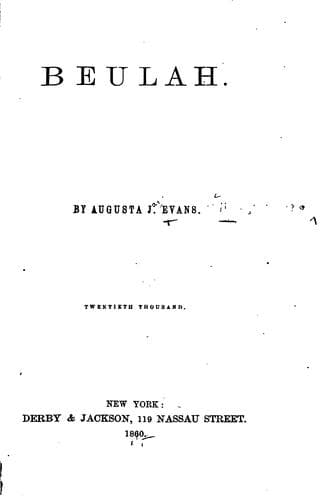
Love stories; Orphans -- Fiction; Southern States -- Fiction; Women -- Fiction
To the discourse which followed Beulah listened with the deepest
interest. She followed the speaker over the desert of ancient
Oriental systems, which he rapidly analyzed, and held up as empty
shells; lifting the veil of soufism, he glanced at the mystical
creed of Algazzali; and, in an epitomized account of the Grecian
schools of philosophy, depicted the wild vagaries into which many
had wandered, and the unsatisfactory results to which all had
attained. Not content with these instances of the insufficiency and
mocking nature of human wisdom and learning, he adverted to the
destructive tendency of the Helvetian and D'Holbach systems, and,
after a brief discussion of their ruinous tenets, dilated, with some
erudition upon the conflicting and dangerous theories propounded by
Germany. Then came the contemplation of Christianity, from it's rise
among the fishermen of Galilee to its present summit of power. For
eighteen hundred years it had been assaulted by infidelity, yet each
century saw it advancing--a conquering colossus. Throughout the
sermon the idea was maintained that human reason was utterly
inadequate to discover to man his destiny, that human learning was a
great cheat, and that only from the pages of Holy Writ could genuine
wisdom be acquired. Men were to be as little children in order to be
taught the truths of immortality. Certainly the reasoning was clear
and forcible, the philosophic allusions seemed very apropos, and the
language was elegant and impassioned. The closing hymn was sung; the
organ hushed its worshiping tones; the benediction was pronounced;
the congregation dispersed.
As Beulah descended the steps she found Pauline and Mrs. Lockhart
waiting at the carriage for her. The latter greeted her with quite a
show of cordiality; but the orphan shrank back from the offered
kiss, and merely touched the extended hand. She had not forgotten
the taunts and unkindness of other days; and, though not vindictive,
she could not feign oblivion of the past, nor assume a friendly
manner foreign to her. She took her seat in the carriage, and found
it rather difficult to withdraw her fascinated eyes from Pauline's
lovely face. She knew what was expected of her, however; and said,
as they drove rapidly homeward:
"Mr. Mortimor seems to be a man of more than ordinary erudition."
"Did you like his sermon? Do you like him?" asked Pauline eagerly.
"I like him very much indeed; but do not like his sermon at all,"
answered Beulah bluntly.
"I am sure everybody seemed to be delighted with it," said Mrs.
Lockhart.
"Doubtless the majority of his congregation were; and I was very
much interested, though I do not accept his views. His delivery is
remarkably impressive, and his voice is better adapted to the pulpit
than any I have ever listened to." She strove to say everything
favorable which, in candor, she could.
"Still you did not like his sermon?" said Pauline gravely.
"I cannot accept his conclusions."
Public-domain text, read in full here on John Shaqi.
Reviews
Reviews
No reviews yet
Be the first to share your thoughts on this work.
Elsewhere in the archive
Join the Discussion
Join the discussion
Sign in to leave a comment or review.
Sign InorCreate an account