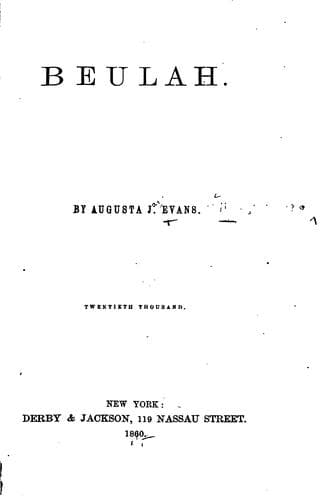
Love stories; Orphans -- Fiction; Southern States -- Fiction; Women -- Fiction
Brown's descent upon Reid greatly interested her. True, there were
very many things she could not assent to; yet the arguments seemed
plausible enough, when lo! a metaphysical giant rescues Reid; tells
her that Brown was an ignoramus; utterly misunderstood the theory he
set himself to criticise, and was a wretched bungler; after which he
proceeds to show that although Brown had not acumen enough to
perceive it, Reid had himself fallen into grave errors and culpable
obscurity. Who was right, or who was wrong, she could not for her
life decide. It would have been farcical, indeed, had she not been
so anxiously in earnest. Beginning to distrust herself, and with a
dawning dread lest after all psychology would prove an incompetent
guide, she put by the philosophies themselves and betook herself to
histories of philosophy, fancying that here all bitter invective
would be laid aside, and stern impartiality prevail. Here the evil
she fled from increased fourfold. One historian of philosophy (who
was a great favorite of her guardian), having lost all confidence in
the subjects he treated, set himself to work to show the fallacy of
all systems, from Anaximander to Cousin. She found the historians of
philosophy as much at variance as the philosophers themselves, and
looked with dismay into the dim land of vagaries into which
metaphysics had drawn the brightest minds of the past. Then her
guardian's favorite quotation recurred to her with painful
significance: "There is no criterion of truth; all is merely
subjective truth." It was the old skeptical palladium, ancient as
metaphysics. She began to despair of the truth in this direction;
but it certainly existed somewhere. She commenced the study of
Cousin with trembling eagerness; if at all, she would surely find in
a harmonious "Eclecticism" the absolute truth she has chased through
so many metaphysical doublings. "Eclecticism" would cull for her the
results of all search and reasoning. For a time she believed she had
indeed found a resting-place; his "true" satisfied her; his
"beautiful" fascinated her; but when she came to examine his
"Theodieea," and trace its results, she shrank back appalled. She
was not yet prepared to embrace his subtle pantheism. Thus far had
her sincere inquiries and efforts brought her. It was no wonder her
hopeful nature grew bitter and cynical; no wonder her brow was bent
with puzzled thought and her pale face haggard and joyless. Sick of
systems, she began to search her own soul; did the very thing of all
others best calculated to harass her mind and fill it with
inexplicable mysteries. She constituted her own reason the sole
judge; and then, dubious of the verdict, arraigned reason itself
before itself. Now began the desperate struggle. Alone and unaided,
she wrestled with some of the grimmest doubts that can assail a
human soul. The very prevalence of her own doubts augmented the
difficulty. On every side she saw the footprints of skepticism; in
Public-domain text, read in full here on John Shaqi.
Reviews
Reviews
No reviews yet
Be the first to share your thoughts on this work.
Elsewhere in the archive
Join the Discussion
Join the discussion
Sign in to leave a comment or review.
Sign InorCreate an account