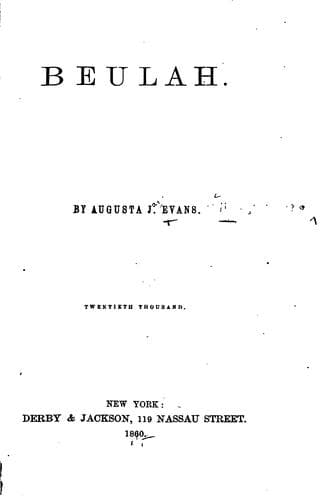
Love stories; Orphans -- Fiction; Southern States -- Fiction; Women -- Fiction
It was dusk when she reached home, and, passing the dining room,
where the tea table awaited her arrival, she sought her own
apartment. A cheerful fire blazed in welcome; but just now all
things were somber to her vision, and she threw herself into a chair
and covered her face with her hands. Like a haunting specter,
Cornelia's haggard countenance pursued her, and a dull foreboding
pointed to a coming season when she, too, would quit earth in
hopeless uncertainty. She thought of her guardian and his skeptical
misanthropy. He had explored every by-path of speculation, and after
years of study and investigation had given up in despair, and
settled down into a refined pantheism. Could she hope to succeed
better? Was her intellect so vastly superior to those who for
thousands of years had puzzled by midnight lamps over these
identical questions of origin and destiny? What was the speculation
of all ages, from Thales to Comte, to the dying girl she had just
left? Poor Beulah! For the first time her courage forsook her, and
bitter tears gushed over her white cheeks. There was no stony
bitterness in her face, but an unlifting shadow that mutely revealed
the unnumbered hours of strife and desolation which were slowly
bowing that brave heart to the dust. She shuddered, as now, in self-
communion, she felt that atheism, grim and murderous, stood at the
entrance of her soul, and threw its benumbing shadow into the inmost
recesses. Unbelief hung its murky vapors about her heart, curtaining
it from the sunshine of God's smile. It was not difficult to trace
her gradual progress if so she might term her unsatisfactory
journey. Rejecting literal revelation, she was perplexed to draw the
exact line of demarcation between myths and realities; then followed
doubts as to the necessity, and finally as to the probability and
possibility, of an external, verbal revelation. A revealed code or
system was antagonistic to the doctrines of rationalism; her own
consciousness must furnish the necessary data. But how far was
"individualism" allowable? And here the hydra of speculation reared
its horrid head; if consciousness alone furnished truth, it was but
true for her, true according to the formation of her mind, but not
absolutely true. Admit the supremacy of the individual reason, and
she could not deny "that the individual mind is the generating
principle of all human knowledge; that the soul of man is like the
silkworm, which weaves its universe out of its own being; that the
whole mass of knowledge to which we can ever attain lies potentially
within us from the beginning; that all truth is nothing more than a
self-development."
She became entangled in the finely spun webs of ontology, and knew
not what she believed. Her guardian's words rang in her ears like a
knell. "You must accept either utter skepticism, or absolute,
consistent pantheism."
A volume which she had been reading the night before lay on the
table, and she opened it at the following passage:
Public-domain text, read in full here on John Shaqi.
Reviews
Reviews
No reviews yet
Be the first to share your thoughts on this work.
Elsewhere in the archive
Join the Discussion
Join the discussion
Sign in to leave a comment or review.
Sign InorCreate an account