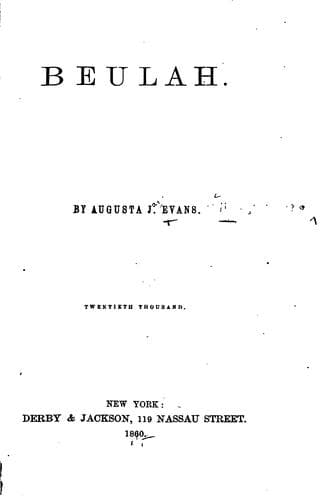
Love stories; Orphans -- Fiction; Southern States -- Fiction; Women -- Fiction
large, restless eyes were sadder than ever, and there were tokens of
languor in every feature. A few months had strangely changed the
countenance once so hopeful and courageous in its uplifted
expression. The wasted form bore evidence of physical suffering, and
the slender fingers were like those of a marble statue. Yet she had
never missed an hour in the schoolroom, nor omitted one iota of the
usual routine of mental labor. Rigorously the tax was levied, no
matter how the weary limbs ached or how painfully the head throbbed;
and now nature rebelled at the unremitted exaction, and clamored for
a reprieve. Mrs. Williams had been confined to her room for many
days by an attack of rheumatism, and the time devoted to her was
generally reclaimed from sleep. It was no mystery that she looked
ill and spent. Now, as she sat watching the silver crescent
glittering in the vest, her thoughts wandered to Clara Sanders, and
the last letter received from her, telling of a glorious day-star of
hope which had risen in her cloudy sky. Mr. Arlington's brother had
taught her that the dream of her girlhood was but a fleeting fancy,
that she could love again more truly than before, and in the summer
holidays she was to give him her hand and receive his name. Beulah
rejoiced in her friend's happiness; but a dim foreboding arose lest,
as in Pauline's case, thorns should spring up in paths where now
only blossoms were visible. Since that letter, so full of complaint
and sorrow, no tidings had come from Pauline. Many months had
elapsed, and Beulah wondered more and more at the prolonged silence.
She had written several times, but received no answer, and
imagination painted a wretched young wife in that distant parsonage.
Early in spring she learned from Dr. Asbury that Mr. Lockhart had
died at his plantation of consumption, and she conjectured that Mrs.
Lockhart must be with her daughter. Beulah half rose, then leaned
back against the column, sighed involuntarily, and listened to that
"still, small voice of the level twilight behind purple hills." Mrs.
Williams was asleep, but the tea table waited for her, and in her
own room, on her desk, lay an unfinished manuscript which was due
the editor the next morning. She was rigidly punctual in handing in
her contributions, cost her what it might; yet now she shrank from
the task of copying and punctuating and sat a while longer, with the
gentle Southern breeze rippling over her hot brow. She no longer
wrote incognito. By accident she was discovered as the authoress of
several articles commented upon by other journals, and more than
once her humble home had been visited by some of the leading
literati of the place. Her successful career thus far inflamed the
ambition which formed so powerful an element in her mental
organization, and a longing desire for fame took possession of her
soul. Early and late she toiled; one article was scarcely in the
hands of the compositor ere she was engaged upon another. She lived,
Public-domain text, read in full here on John Shaqi.
Reviews
Reviews
No reviews yet
Be the first to share your thoughts on this work.
Elsewhere in the archive
Join the Discussion
Join the discussion
Sign in to leave a comment or review.
Sign InorCreate an account