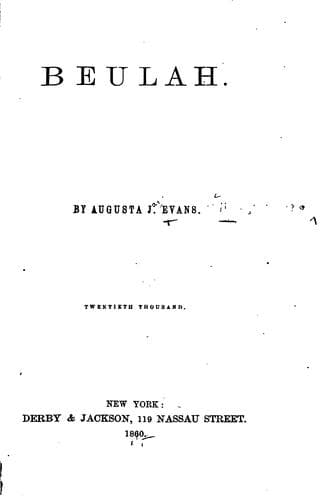
Love stories; Orphans -- Fiction; Southern States -- Fiction; Women -- Fiction
As regarded her deportment toward her husband,
one alteration was perceptible; she respected--almost feared him;
shrank from his presence, and generally contrived to fill the house
with company when she was, for short intervals, at home. He ceased
to upbraid, or even remonstrate; his days were spent in the
courtroom or his office, and his evenings in his library. She
dressed as extravagantly as she chose; he made no comments, paid her
accounts, and grew more taciturn and abstracted day by day.
Oh, woman! woman! when will you sever the fetters which fashion,
wealth, and worldliness have bound about you, and prove yourselves
worthy the noble mission for which you were created? How much longer
will heartless, soulless wives, mothers, daughters, and sisters
waltz, moth-like, round the consuming flame of fashion; and, by
neglecting their duties and deserting their sphere, drive their
husbands, sons, and brothers out into the world, reckless and
depraved, with callous hearts, irrevocably laid on the altars of
Mammon? God help the women of America! Grant them the true womanly
instincts which, in the dawn of our republic, made "home" the Eden,
the acme of all human hopes and joys. Teach them that gilded
saloons, with their accompanying allurements of French latitude in
dress and dancing, and the sans-souci manners and style of
conversation (which, in less degenerate times, would have branded
with disgrace and infamy all who indulged it), teach them that all
these tend to the depths of social evil; and oh, lead them back to
the hearthstone, that holy post which too many, alas, have deserted!
Eugene Graham's love and tenderness were all bestowed on his
daughter, a beautiful child, not yet five years old; the sole
companion of the hours spent at home, she became his idol.
It was one sunny afternoon that he finished copying some papers,
necessary in a case to be defended the following day. The sunshine,
stealing through the shutters, fell on his lofty brow, pale from
continued study; his whole countenance bespoke a nature saddened,
vexed, but resolute, and, leaning forward, he touched the bell-rope.
As he did so, there came quick footsteps pattering along the hall;
the door was pushed open, and a little fairy form, with a head of
rich auburn ringlets, peeped in cautiously, while a sweet, childish
voice asked eagerly:
"May I come now, father? Have you done writing? I won't make a
noise; indeed I won't!"
The gloom fled from his face, and he held out his arms to her,
saying:
"I have done writing; you may come now, my darling."
Public-domain text, read in full here on John Shaqi.
Reviews
Reviews
No reviews yet
Be the first to share your thoughts on this work.
Elsewhere in the archive
Join the Discussion
Join the discussion
Sign in to leave a comment or review.
Sign InorCreate an account