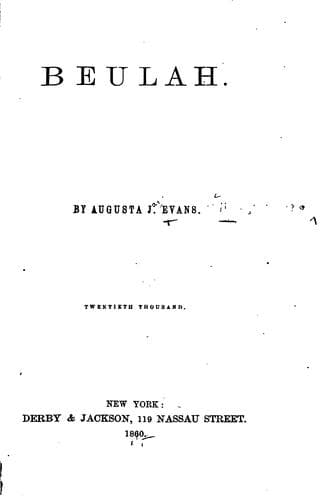
Love stories; Orphans -- Fiction; Southern States -- Fiction; Women -- Fiction
"There is a letter from Heidelberg. I had almost forgotten it. You
will have time to read it; the buggy is not ready." He moved his
fingers slightly, so as to see her distinctly, while she tore off
the envelope and perused it. At first she looked pleased; then the
black eyebrows met over the nose, and as she refolded it there was a
very decided curl in the compressed upper lip. She put it into her
pocket without comment.
"Eugene is well, I suppose?" said the doctor, still shading his
eyes.
"Yes, sir; quite well."
"Does he seem to be improving his advantages?"
"I should judge not, from the tone of this letter."
"What does it indicate?"
"That he thinks of settling down into mercantile life on his return;
as if he needed to go to Germany to learn to keep books." She spoke
hastily and with much chagrin.
"And why not? Germany is par excellence the land of book-making, and
book-reading; why not of bookkeeping?"
"German proficiency is not the question, sir."
Dr. Hartwell smiled, and, passing his fingers through his hair,
replied:
"You intend to annihilate that plebeian project of his, then?"
"His own will must govern him, sir; over that I have no power."
"Still you will use your influence in favor of a learned
profession?"
"Yes, sir; if I have any."
"Take care your ambitious pride does not ruin you both. There is the
buggy. Be so good as to give me my fur gauntlets out of the drawer
of my desk. That will do; come."
The ride was rather silent. Beulah spoke several times, but was
answered in a manner which informed her that her guardian was in a
gloomy mood and did not choose to talk. He was to her as
inexplicable as ever. She felt that the barrier which divided them,
instead of melting away with long and intimate acquaintance, had
strengthened and grown impenetrable. Kind but taciturn, she knew
little of his opinions on any of the great questions which began to
agitate her own mind. For rather more than three years they had
spent their evenings together; she in studying, he in reading or
writing. Of his past life she knew absolutely nothing, for no
unguarded allusion to it ever escaped his lips. As long as she had
lived in his house, he had never mentioned his wife's name, and but
for his sister's words she would have been utterly ignorant of his
marriage. Whether the omission was studied, or merely the result of
abstraction, she could only surmise. Once, when sitting around the
fire, a piece of crape fell upon the hearth from the shrouded
portrait. He stooped down, picked it up, and, without glancing at
the picture, threw the fragment into the grate. She longed to see
the covered face, but dared not unfasten the sable folds, which had
grown rusty with age. Sometimes she fancied her presence annoyed
him; but if she absented herself at all during the evening he
invariably inquired the cause. He had most scrupulously avoided all
reference to matters of faith; she had endeavored several times to
Public-domain text, read in full here on John Shaqi.
Reviews
Reviews
No reviews yet
Be the first to share your thoughts on this work.
Elsewhere in the archive
Join the Discussion
Join the discussion
Sign in to leave a comment or review.
Sign InorCreate an account