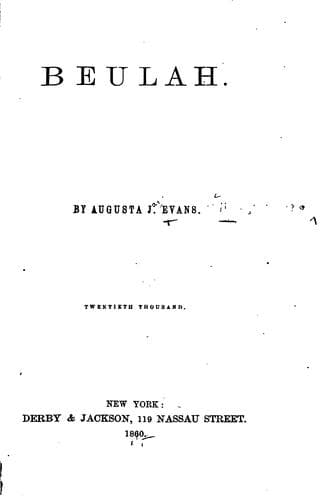
Love stories; Orphans -- Fiction; Southern States -- Fiction; Women -- Fiction
Beulah practiced perseveringly for some time, and then, drawing a
chair near the fire, sat down and leaned her head on her hand. She
missed her guardian--wanted to see him--felt surprised at his sudden
departure and mortified that he had not thought her of sufficient
consequence to bid adieu to and be apprised of his intended trip. He
treated her precisely as he did when she first entered the house;
seemed to consider her a mere child, whereas she knew she was no
longer such. He never alluded to her plan of teaching, and when she
chanced to mention it he offered no comment, looked indifferent or
abstracted. Though invariably kind, and sometimes humorous, there
was an impenetrable reserve respecting himself, his past and future,
which was never laid aside. When not engaged with his flowers or
music, he was deep in some favorite volume, and, outside of these
sources of enjoyment, seemed to derive no real pleasure.
Occasionally he had visitors, but these were generally strangers,
often persons residing at a distance, and Beulah knew nothing of
them. Several times he had attended concerts and lectures, but she
had never accompanied him; and frequently, when sitting by his side,
felt as if a glacier lay between them. After Mrs. Chilton's
departure for New York, where she and Pauline were boarding, no
ladies ever came to the house, except a few of middle age, who
called now and then to see Mrs. Watson, and, utterly isolated from
society, Beulah was conscious of entire ignorance of all that passed
in polite circles. Twice Claudia had called, but, unable to forget
the past sufficiently to enter Mrs. Grayson's house, their
intercourse had ended with Claudia's visits. Mrs. Watson was a kind-
hearted and most excellent woman, who made an admirable housekeeper,
but possessed few of the qualifications requisite to render her an
agreeable companion. With an ambitious nature, and an eager thirst
for knowledge, Beulah had improved her advantages as only those do
who have felt the need of them. While she acquired, with unusual
ease and rapidity, the branches of learning taught at school, she
had availed herself of the extensive and select library, to which
she had free access, and history, biography, travels, essays, and
novels had been perused with singular avidity. Dr. Hartwell, without
restricting her reading, suggested the propriety of incorporating
more of the poetic element in her course. The hint was timely, and
induced an acquaintance with the great bards of England and Germany,
although her taste led her to select works of another character. Her
secluded life favored habits of study, and, at an age when girls are
generally just beginning to traverse the fields of literature, she
had progressed so far as to explore some of the footpaths which
entice contemplative minds from the beaten track. With earlier
cultivation and superiority of years, Eugene had essayed to direct
her reading; but now, in point of advancement, she felt that she was
in the van.
Public-domain text, read in full here on John Shaqi.
Reviews
Reviews
No reviews yet
Be the first to share your thoughts on this work.
Elsewhere in the archive
Join the Discussion
Join the discussion
Sign in to leave a comment or review.
Sign InorCreate an account