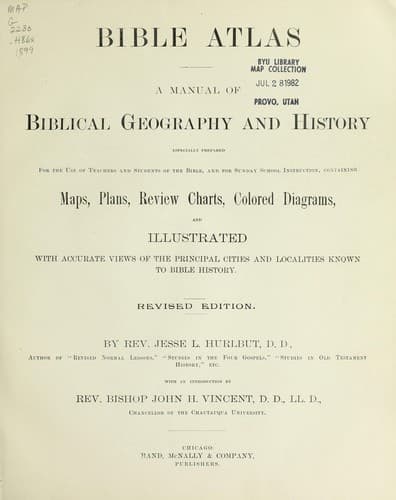
Bible Atlas: A Manual of Biblical Geography and HistoryHurlbut, Jesse Lyman
Religion
Bible Atlas: A Manual of Biblical Geography and History
Hurlbut, Jesse Lyman
Bible -- Geography; Bible -- Geography -- Maps; Bible -- History of Biblical events
[Illustration: SOLOMON'S POOLS.]
II. =The Eastern Road= from Jerusalem leads through a barren region of
crags and ravines, almost without inhabitants, except the robbers who
have haunted it since the days when "a certain man went down from
Jerusalem to Jericho, and fell among thieves." (Luke 10:30.) The road is
a continual descent from a height of 2,700 feet above the sea to 1,300
feet below it, in 20 miles.
The only place passed on the route is _Bethany_ (now _el Azariyeh_), the
home of Mary and Martha, the place where Lazarus was raised from death,
and near which Jesus ascended. (Luke 24:50.) It is on the eastern slope
of the Mount of Olives, and about a mile and a quarter from Jerusalem.
Beyond this place the road grows more steep, descending toward the
Jordan Valley.
III. =The Southern Road=, leading along the crest of the hill country
toward Hebron, also passes few places of historical interest.
1. Just south of the city is the _Plain of the Rephaim_, where, after
the capture of Jerusalem, David twice met and vanquished the
Philistines. (2 Sam. 5:18-25.) The name may be a reminiscence of the
most ancient people who inhabited the mountain region of Palestine,
before the Amorites were in the land.
2. Four miles from the city the traveler passes _Rachel's Tomb_. This
may represent the place where Jacob, while journeying southward, lost
his beloved wife Rachel, the mother of Joseph and Benjamin. (Gen.
35:16-20.) The monument now standing is of comparatively recent date;
but it may occupy the site of one more ancient.
3. Six miles southeast of the city we come to _Bethlehem_, a small town,
yet having the deepest interest as the birthplace of David, and of
David's greatest descendant, the Saviour of the world. It lies upon the
side and summit of a steep hill, and contains now about 2,000
inhabitants. Many places connected with the birth of Jesus are shown;
but there is no authority for their precise location except tradition.
In a cave near this village Jerome wrote most of his translation of the
Bible, the Vulgate version, recognized as the standard Bible by the
Roman Catholic Church.
4. A little beyond Bethlehem is the head of the _Valley of Elah_, in
which, but at a distance to the west, David fought with Goliath, and
gained his earliest honors before Israel. (1 Sam. 17.)
5. There are no more places of interest to the Bible reader until we
reach _Hebron_, 18 miles from Jerusalem. This is one of the most ancient
towns in the world, occupied before the time of Abraham; the burial
place of the Patriarchs, the capital of David's kingdom of Judah, and
the place where Absalom's rebellion was begun. It is still a large town,
inhabited by intolerant Mohammedans, who closely guard the sanctity of
the Mosque which covers the graves of Abraham, Isaac and Jacob. It is
now called _el Khalil_, "the Friend," _i. e._, Abraham, "the friend of
God."
Public-domain text, read in full here on John Shaqi.
Reviews
Reviews
No reviews yet
Be the first to share your thoughts on this work.
Elsewhere in the archive
Join the Discussion
Join the discussion
Sign in to leave a comment or review.
Sign InorCreate an account