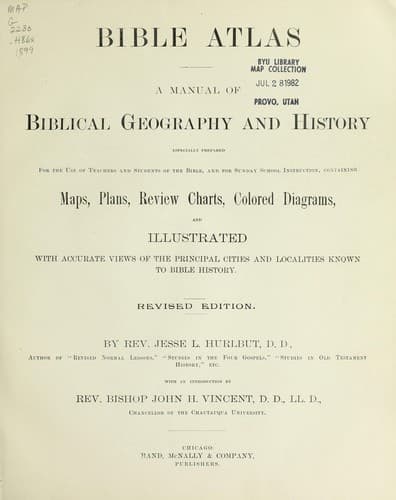
Bible Atlas: A Manual of Biblical Geography and HistoryHurlbut, Jesse Lyman
Religion
Bible Atlas: A Manual of Biblical Geography and History
Hurlbut, Jesse Lyman
Bible -- Geography; Bible -- Geography -- Maps; Bible -- History of Biblical events
The principal events of this period were as follows: (1.) The accession
of Hazael in Syria, Jehu in Israel, and Athaliah in Judah, B.C. 842.
(2.) The destruction of Baal worship in Israel. (2 Kings 10.) (3.) The
conquests of Hazael on the east of Jordan. (2 Kings 10:32, 33.) (4.) The
slaughter of Athaliah, and accession of Jehoash in Judah. (2 Kings 11.)
(5.) The repairs of the Temple by Jehoiada. (2 Kings 12.) (6.) The
prophecies of Jonah and Joel. (7.) The subjection of Israel under
Hazael. (8.) Hazael's campaign against Judah, and capture of Gath. (9.)
The death of Hazael.
3. =The Restoration of Israel=, B.C. 779-742. The Syrian conqueror,
Hazael, left as his successor a weak prince, Ben-hadad III., who was
unable to hold his dominions against the ability of the third king of
the house of Jehu in Israel, Jehoash, or Joash, and his greater son,
Jeroboam II. Under these two able rulers the kingdom of the Ten Tribes
arose to its culmination, the territory lost was regained, nearly all
Syria was conquered, Judah was made tributary, and Samaria gave laws to
a large part of Solomon's empire. This period was marked as the era of
two great prophets, Jonah and Joel; and, from its brilliant but brief
prosperity, has been called "the Indian Summer of Israel." At the
opening of this epoch, Amaziah reigned in Judah. He won a victory in
Edom, but, venturing to attack Israel, was routed at Beth-shemesh; and,
for the only time in Judah's history, the army of the Ten Tribes entered
Jerusalem as victors. (2 Kings 14.) Uzziah, his successor, was more
successful, and held his kingdom in security both against Israel and the
enemies on the south. The outline map represents the kingdoms during the
reign of Jeroboam II., about B.C. 800.
4. =The Fall of Israel=, B.C. 742-721. The decline of Israel after the
reign of Jeroboam II. was rapid. A succession of usurpers seized the
throne, the foreign conquests melted away, and anarchy prevailed. The
cause of these sudden changes was the growth of the Assyrian power under
a succession of warlike kings, who made Nineveh the capital of the
Eastern world. Syria fell before their arms, and Israel soon followed.
In the reign of Menahem, Israel became tributary to Assyria; and in that
of Pekah, B.C. 735, the portion of Israel on the north, including the
tribe of Naphtali, was carried into captivity by Tiglath-pileser. (2
Kings 15:29.) In the reign of Hoshea, Samaria itself was taken (B.C.
721) by Sargon (having been besieged by Shalmaneser); and the Ten Tribes
were finally carried into captivity to Halah and Habor. (2 Kings 17.)
This period belongs to the map of the Assyrian Empire.
Public-domain text, read in full here on John Shaqi.
Reviews
Reviews
No reviews yet
Be the first to share your thoughts on this work.
Elsewhere in the archive
Join the Discussion
Join the discussion
Sign in to leave a comment or review.
Sign InorCreate an account